

J.C. Derrick
Key Points
- A town hall at St. Paul AME Church discussed Florida's recent congressional redistricting and its impact on Black voting rights.
- Speakers linked current voting debates to historical voter suppression and called for increased civic engagement and voter participation.
- State Rep. Doug Bankson defended the new district maps as legally compliant and not based on race or party.
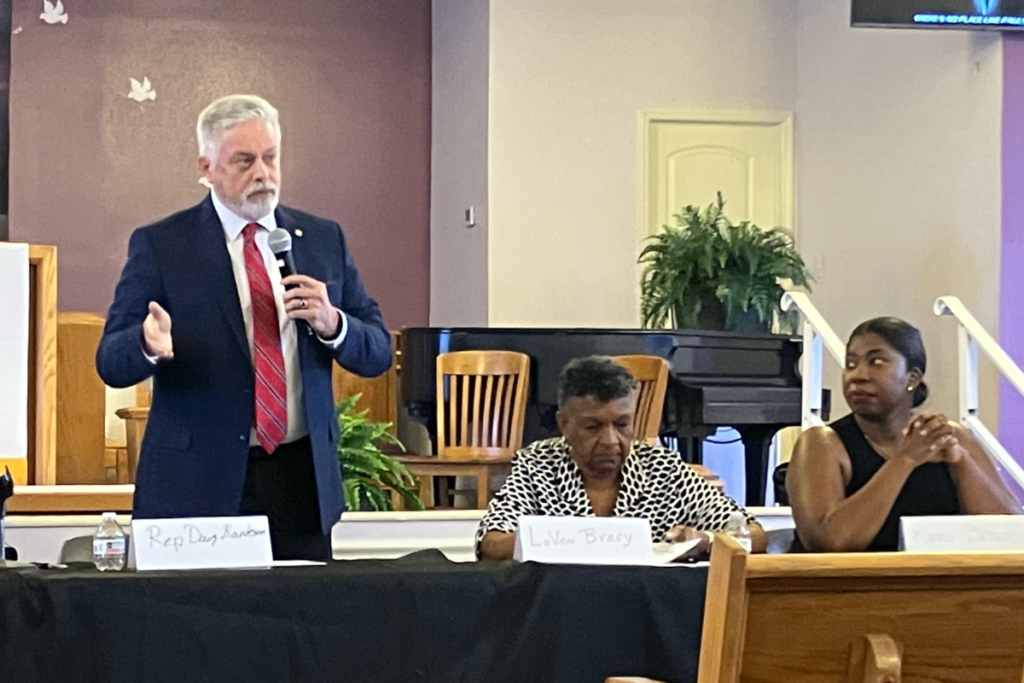
Concerns over redistricting, voter access and political representation drew residents, clergy, activists and elected officials to St. Paul AME Church Thursday night for a town hall discussion, which organizers said was intended to address what they described as systemic attacks on Black voting rights, history and culture.
The nearly two-hour forum, held inside the church sanctuary on South Park Avenue, focused heavily on Florida’s recent congressional redistricting efforts and whether new maps dilute minority voting strength through partisan gerrymandering.
The controversy stems from a special legislative session this year in which Florida lawmakers revisited congressional district maps midway through the decade, an unusual move critics argued could weaken minority voting influence.
The panel included State Rep. Doug Bankson, R-Apopka; Ocoee City Commissioner George Oliver III; former State Rep. Kamia Brown; civil rights advocates Larry Colleton and Dr. LaVon Wright Bracy; and Apopka historian Francina Boykin. State Rep. Bruce Hadley Antone later joined the discussion.
While multiple speakers criticized the redistricting process and broader voting policies, Bankson faced some of the evening’s toughest questions and criticisms from audience members and fellow panelists about his support of the new maps. He repeatedly cited Supreme Court precedent saying race and political party cannot be considered when drawing district maps, and that he thought the maps looked fair, not gerrymandered.
The discussion opened with historical context tying modern voting debates to the Civil Rights Movement and the 1965 Selma voting rights marches. Speakers repeatedly referenced Florida’s history of voter suppression and argued that current redistricting efforts reflect newer versions of longstanding political battles.
Several speakers also tied the debate to broader national political tensions, including references to President Donald Trump, Project 2025 and Republican-led voting policies.
Moderator Monica May told attendees the town hall was intended to help residents understand both redistricting and gerrymandering.
“Are we choosing our politicians, or are our politicians choosing their voters?” May asked during the forum.
Colleton, whose several roles include serving as president of the Florida Voters League, argued the process moved unusually quickly and gave lawmakers little opportunity for public input before the maps were approved.
“The governor of this state called a special session for three days,” Colleton said. “He submitted his own map … and in three days his map got approved by that super majority.”
Brown argued the latest redistricting effort weakened protections intended to prevent partisan manipulation.
“It doesn’t make it right, but from a federal standpoint, this thing is going to really be hard based off of what the Supreme Court just did,” Brown said, referring to the recent Louisiana v. Callais Supreme Court decision, which involved congressional redistricting and Section 2 of the Voting Rights Act. “However, we still have Fair District Amendment Four and Five here in the state.”
Audience members pressed Bankson directly on why he supported the maps despite concerns that communities such as Apopka could again be split between congressional districts.
“How are we perceiving different things, and we’re looking at the exact same thing?” attendee Keyomi Jones asked Bankson during a tense exchange.
Bankson defended his vote by saying he believed the maps complied with legal standards prohibiting districts from being drawn explicitly by race or party affiliation.
“If I believed that this was specifically targeting to remove the right to vote based upon the color of their skin, I absolutely would not support that,” Bankson said.
He acknowledged discomfort with the mid-decade process and told attendees he remained open to further conversations.
“I knew this would create this kind of firestorm with you, and I’m here tonight,” Bankson said, mentioning his granddaughter’s graduation was that same night. “I could have easily skipped this.”
At several points, audience members challenged Bankson over whether the maps effectively diluted Black voting power despite being framed as partisan rather than racial redistricting.
Oliver connected the issue to broader concerns about political accountability and civic participation.
“As [philosopher and writer] George Santayana said, if we don’t understand our history, we are doomed to repeat it,” Oliver said. “And guess what we’re doing right now? We’re repeating it right now.”
The meeting also touched on voter ID proposals, restoration of voting rights for returning citizens and concerns about voter participation.
“Everybody’s got to go vote,” Antone told attendees. “That is the answer to whatever you’re dealing with right now.”
Following the town hall, Pastor Hezekiah Bradford Jr. said he attended the forum because he was concerned about voter apathy, redistricting and gerrymandering, and wanted residents to receive information about issues affecting their voting power.
Bradford, who said he has worked closely with Bankson through local ministry efforts, questioned the representative during the forum about previous conversations they had regarding gerrymandering and redlining.
“The dialog was a little heated, but I think it was necessary,” Bradford said after the meeting.
Bradford said he was not fully satisfied with Bankson’s explanation for supporting the maps.
“If wrong is wrong, wrong is wrong,” Bradford said. “This may be legal, but is it right?”
Bradford said he believes many residents are concerned that redistricting can dilute the political influence of communities by reshaping district boundaries.
“I always thought that we vote because we choose who we want, but I think gerrymandering, it chooses us,” Bradford said.
He said local pastors, community groups and youth organizations must continue working to increase civic engagement and voter participation, particularly among younger residents.
“I’m going to try my very best to get people to vote, to get out and vote,” Bradford said. “Voting is important.”
Multiple parts of the town hall’s livestream are available on the St. Paul AME Church’s Facebook page.
Author
Suggested Articles
No related articles found.