



Official photo
Key Points
When this article is published, the Florida Legislature will have completed its first special session for 2026. Legislators convened starting Tuesday to discuss Gov. Ron DeSantis’ draft (released Monday) congressional redistricting map, an Artificial Intelligence (AI) Bill of Rights and medical freedom bill.
Although bills were filed in the Senate for the AI Bill of Rights and medical freedom, because the House did not file companion bills, these issues were ultimately not discussed once the Legislature convened.
The primary focus of this special session was to discuss and vote on the draft congressional redistricting map. The map, as released, appeared to give Republicans a 24–4 advantage over Democrats, up from their current 20–8 advantage. Florida’s federal delegation is currently represented by 20 Republicans and seven Democrats, with an eighth Democratic seat vacant following the resignation of former Rep. Sheila Cherfilus-McCormick.
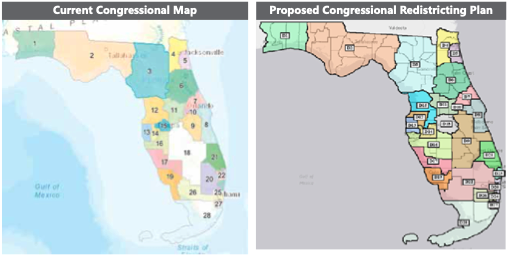
According to a statement Gov. DeSantis made to Fox News, his mid-decade redistricting proposal “more fairly represents the make-up of Florida today.”
This week the Legislature was tasked with voting on the map, which passed 83–28 in the House and 21–17 in the Senate, and it will apply to the 2026 mid-term elections once signed by the governor.
The Legislature also revisited (but did not discuss) one of the hot topics from the 2026 regular session, AI, with a bill creating an “Artificial Intelligence Bill of Rights.” This bill attempted to address the gap between the emergence of AI and current law by adding regulations to protect Floridians.
Specifically, the bill included consumer protections for minors, chatbot disclosures, interaction monitoring and personal information. Additionally, this bill placed limitations on government contracting with entities for AI services, if such entities have ties to a government of a foreign country of concern.
Further, this bill prohibits a person from publicly using for trade or for any commercial or advertising purpose the name, portrait, photograph, image, or other likeness of an individual created through generative AI without the express written or oral consent to such use.
Lastly, the bill proposed a framework for AI use as an educational tool, providing for parental notices, opt-outs and limitations.
Legislators revisited another proposal (but did not discuss) that Gov. DeSantis had announced several months back, medical freedom exemption from mandatory vaccines for children. This bill created a statutory nonmedical exemption from immunization requirements for a child attending a K‑12 school, if the vaccine conflicts with the parents’ conscience. Like the existing religious exemption, the conscience-based exemption would also be available to parents with children attending preschool, day care, childcare facility or family day care home facility who are subject to such requirements.
Legislators are expected to return to Tallahassee May 11–29 to finalize the fiscal year 2026–27 state budget, having now reached an agreement on allocations. Another (and likely final) special session is also expected to occur later this summer to discuss property taxes.
Author
Suggested Articles
No related articles found.