



J.C. Derrick
Key Points
- The HCA Florida Wekiva Emergency Center in Orange County opened on March 10 with over 100 trees and 24 species on a 2-acre site to reduce heat impact.
- Tree canopy at the facility helps cool the building, reduce water and fertilizer needs, and can absorb up to 40,000 gallons of water annually to help mitigate flooding.
- The tree canopy and landscaping were integrated early in planning for the HCA Florida Wekiva Emergency Center to retain existing trees and add new ones.
A newly developed emergency facility along West Orange Blossom Trail is drawing attention for incorporating a tree canopy and landscaping into its design, an approach that differs from surrounding development patterns along the corridor.
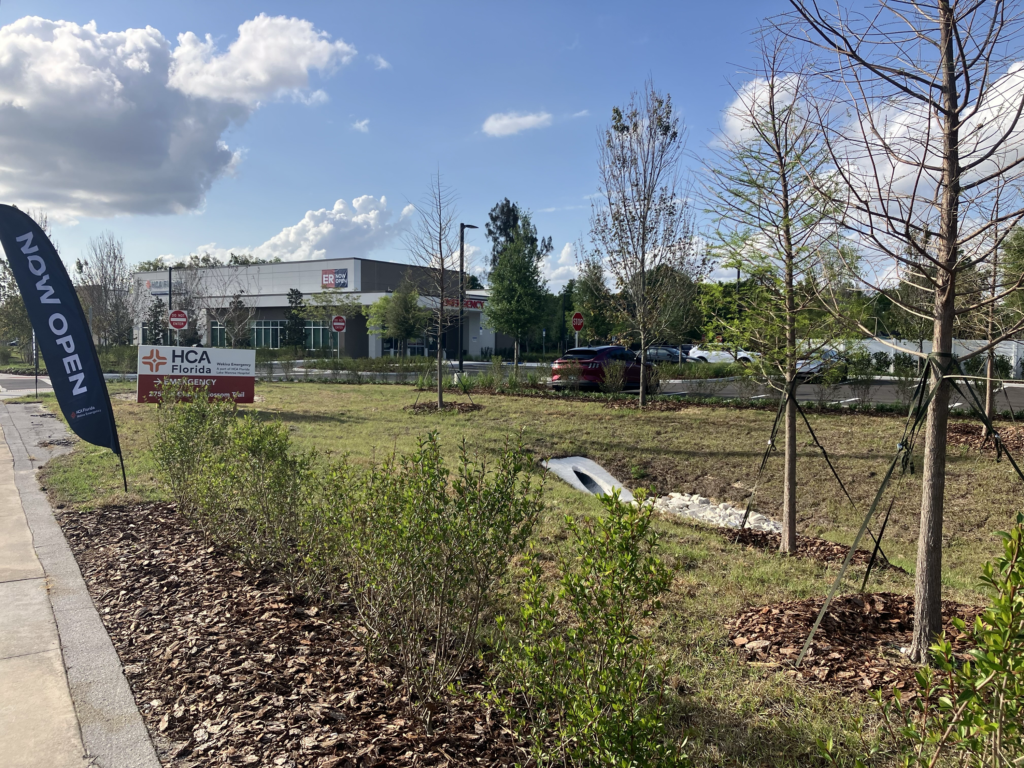
The HCA Florida Wekiva Emergency Center, located along U.S. 441 in unincorporated Orange County, includes more than 100 trees representing 24 species on a roughly 2-acre site that also contains a building and parking. The facility welcomed the community to a ribbon cutting on Feb. 27 ahead of a March 10 opening.
The landscaping approach was incorporated early in the planning process, according to John Gerhold, CEO of HCA Florida Lake Monroe Hospital, who oversaw the freestanding ER project in Apopka.
“That was part of the early stages,” Gerhold said in an interview with The Apopka Chief. “Once we acquired the property, we certainly recognized there were some trees on the property that [should] remain.”
Gerhold said the project team retained existing trees and added another 100 trees, along with about two dozen species of flowering plants and bushes, enhancing the site to surpass its previous condition.
“We were able to retrofit a building on the property at the same time we retained the existing trees,” he said.
The facility is located within an area identified by Dr. Phyllis Olmstead, Orange Soil and Water Conservation District supervisor, as a heat island based on Arbor Day Foundation mapping.
“When you drive along there, all you see is concrete, asphalt and buildings,” Olmstead said.
She said the area previously included orange groves and, before that, a longleaf pine forest, but lost much of its tree canopy over time as development expanded along the corridor.
“This whole zone was red, orange and yellow,” Olmstead said of the heat mapping, adding that “you have nothing left for canopy.”
Olmstead said she was “flabbergasted” by the number and size of trees installed at the site, describing it as uncommon for a developed parcel.
“You don’t see that inside a community anymore,” she said.
She said a tree canopy can reduce temperatures through shade and evapotranspiration, a process in which trees release moisture into the air.
“You cool down when the wind blows on you when you sweat, and that causes the cooling effect,” she said. “The trees are sweating.”
Olmstead also said mature trees can absorb significant amounts of water annually, which she said could help mitigate flooding in nearby areas.
“Any full-grown tree can bring anywhere from 10,000 to 40,000 gallons of water a year,” she said, adding that large-scale planting could have a cumulative effect in areas prone to flooding.
Gerhold said incorporating landscaping into the project did increase costs but was not treated as a limiting factor.
“It definitely added cost to the property, adding the trees,” he said. “But the cost of adding greenery [is] not a cost that we think about.”
He said a tree canopy can provide long-term operational and environmental benefits.
“It’s going to help reduce the fertilizer needs, it’s going to help reduce the water needs, and it’s ultimately going to keep the building cooler,” Gerhold said.
Gerhold said the approach taken at the Wekiva Emergency Center reflects broader practices within the organization, though implementation varies by site.
“It depends on the physical layout of the property,” he said. “Some properties need more landscape than others. This one definitely needed more landscape that wasn’t existing before.”
Olmstead said she believes similar approaches could be applied more broadly, including on commercial properties and existing developments.
“It can be replicated everywhere,” she said.