


Courtesy of Scott Stewart
Key Points
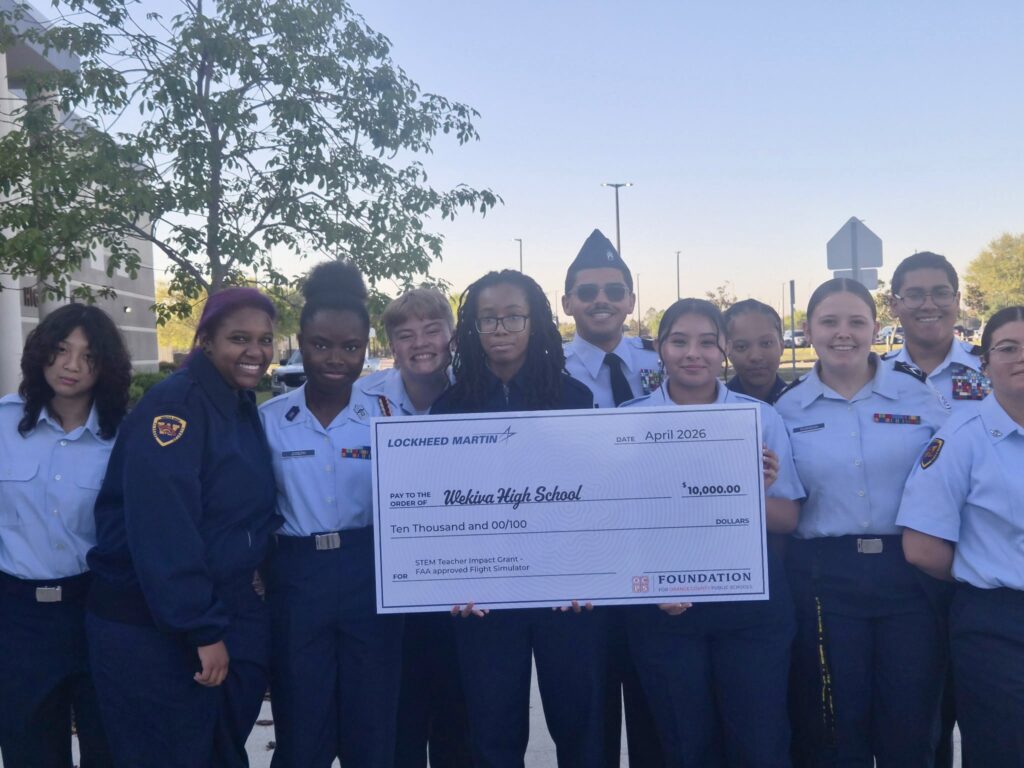
- Lockheed Martin and the Foundation for Orange County Public Schools awarded Wekiva High a $10,000 grant to buy two flight simulators for AFJROTC.
- Wekiva's aviation program will start FAA-approved ground school in junior year and offer in-flight training for seniors.
- The long-term goal is for students to earn pilot licenses and prepare for aviation careers by using simulators and advanced curriculum.
Lockheed Martin, in partnership with the Foundation for Orange County Public Schools (OCPS), awarded Wekiva High School a $10,000 grant to purchase two flight simulators for its Air Force Junior Reserve Officer Training Corps (AFJROTC) program.
“The JROTC program instructors are partnering with a Civil Air Patrol officer to build these simulators from scratch, providing exceptional hands-on technical experience for students and staff,” a statement from the Foundation for OCPS said. “They are also working closely with their administrative team to develop the curriculum needed to launch aviation classes for the new school year. The long-term goal is to create a pathway that allows students to earn their small pilot licenses before graduating high school.”
The Foundation for OCPS presented the award at Wekiva’s Military Recruitment Day on March 23, which Wekiva AFJROTC senior instructor Scott Stewart organized.
“I had this concept when I got here, and I was like, ‘Okay, we have to do something for our kids that’s more than just a high school diploma, and what better way than to try to get a simulator going?’” Stewart said. “If we could bring this and get this matured, look at what the kids could walk out with — a high school diploma and a beginner’s pilot license. Or maybe they want to be air traffic controllers, be mechanics — the spinoff jobs from this, as well.”
The two simulators expected to be available at the start of the coming school year are considered Basic Aviation Training Devices (BATD). Each would feature three monitors imitating the cockpit windows and a smaller monitor with flight instruments. Of the 40 total hours required for a private pilot certificate, up to 2.5 hours of training in a BATD simulator with an instructor would be credited.
“Juniors in their first year would participate in classroom training equivalent to a Federal Aviation Agency (FAA) approved Private Pilot Ground school,” said the concept paper for Wekiva’s aviation orientation and flight training program. “The private pilot ground school would provide essential theoretical knowledge required to pass the FAA written test.”
According to the concept paper, students in eleventh grade will learn about aerodynamics, aircraft systems, meteorology, FAA regulations, and more. They would then take a test after completing ground school.
A group of senior students would advance from classroom training to receive in-flight instruction from a partnering flight school at a local airport, like Orlando Apopka Airport (X04). Those not chosen to receive in-flight instruction would continue with “advanced ground school training.” Seniors will learn about instrument flight, aircraft design, aviation medicine, aviation psychology and more.
In the future, Stewart hopes Wekiva will receive at least one Advanced Aviation Training Device (AATD), which would “replicate the cockpit environment and performance characteristics of a specific class of aircraft (e.g., single-engine piston, multi-engine piston) or even a particular make and model.”
“Phase 2 is what transforms the program from simulator-based learning into a true, FAA-aligned aviation pipeline, giving students authentic flight experience and increasing their competitiveness for postsecondary aviation programs and careers,” the Foundation for OCPS statement said.