



Courtesy of city of Apopka
Key Points
- The Development Review Committee reviewed a 109-lot subdivision plan for 1920 Sheeler Avenue with changes from an earlier 115-unit proposal.
- The subdivision's stormwater tract was increased from six to nine acres while unit count was reduced in the latest plan submission.
- Officials debated whether roads and stormwater infrastructure would be publicly or privately maintained, with HOA likely responsible for stormwater.
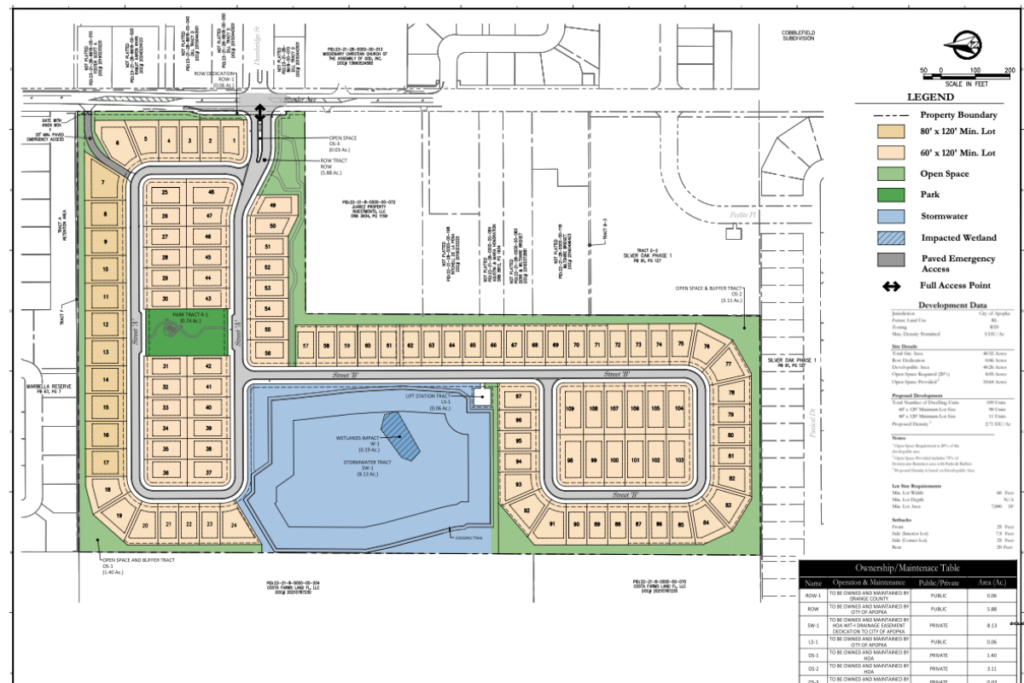
The Development Review Committee (DRC) on Wednesday reviewed the construction site plan for a proposed 109‑lot subdivision on Sheeler Avenue, as city staff and project engineers worked through stormwater infrastructure details and whether the subdivision’s roads and drainage system should be publicly or privately owned and maintained.
The proposal, titled 1920 Sheeler Park, appeared before the committee as a first-submittal construction site plan (CSP) for property at 1920 Sheeler Ave. The applicant, Pape-Dawson Consulting Engineers, submitted the plans on behalf of property owners Marvin Reid and Susan Reid.
Project manager Jun Sohn told the committee the subdivision had been revised from earlier plans.
“They originally proposed 115 units for MDP [major development plan],” Sohn said. “With a CSP, they reduced their units to 109, and stormwater tract increased from about six acres to nine acres. These are major changes from MDP to CSP.”
Sohn also noted the project’s major development plan was scheduled to go before the City Commission later that evening.
During the discussion, engineer Marc Stehli of Pape-Dawson addressed several technical comments raised by city staff, particularly regarding whether infrastructure within the subdivision would ultimately be publicly or privately maintained.
Stehli told the committee that one of the key unresolved issues is how earlier conditions on the project will affect whether the subdivision’s roads and utilities are treated as public or private infrastructure, and who will ultimately be responsible for owning and maintaining them.
Dale Smith of the city public works department said some infrastructure maintenance responsibilities would depend on the final ownership structure.
“The HOA would be responsible to maintain the storm water,” Smith said. “When we get into the planning process, we’ll have an emergency easement over the storm water pond, just in case something happens that we have to go in there and do something to prevent houses from flooding.”
City staff and Stehli also discussed storm drainage placement, street trees and the proposed location of a jogging trail near stormwater maintenance areas.
“I really don’t want trees planted on top of the storm drain,” Smith said during the discussion.
Stehli said the project team was attempting to balance infrastructure requirements with the site’s topography.
“This is a big depression,” Stehli said. “We have a lot of topography that we’re working through here.”
The committee did not take formal action approving the construction site plan Wednesday, with staff indicating outstanding comments would need to be addressed before approval could be recommended.
The DRC also reviewed a seven-lot residential subdivision proposal called Lester Oaks at 550 W. Lester Road and discussed a special exception request for Carolina Textiles, an industrial project seeking approval for outdoor storage and overnight parking along South Bradshaw Road.
During discussion of the Carolina Textiles proposal, a representative for the applicant said the outdoor storage area would primarily be used for semi-trailers connected to a textile recycling operation.
The DRC reviews projects for technical compliance with city requirements before proposals move forward through the city’s broader development approval process.
Author
Suggested Articles
No related articles found.