



Teresa Sargeant
Key Points
- OCPS leaders warned that rapidly rising employee healthcare costs are straining finances and could reduce funds for raises and classroom support.
- OCPS plans to increase its healthcare contribution from $10,555 to $11,611 per employee, potentially needing an extra $145 million over two years to maintain the plan.
- The district urges voters to renew a one-mill property tax on Nov. 3 that funds about 2,000 positions and supports 90% of teacher and staff compensation.
Orange County Public Schools (OCPS) leaders on Tuesday said rapidly rising employee healthcare costs are creating financial pressures that could reduce money available for raises and classroom support, while urging voters to renew a one-mill property tax that funds about 2,000 district positions.
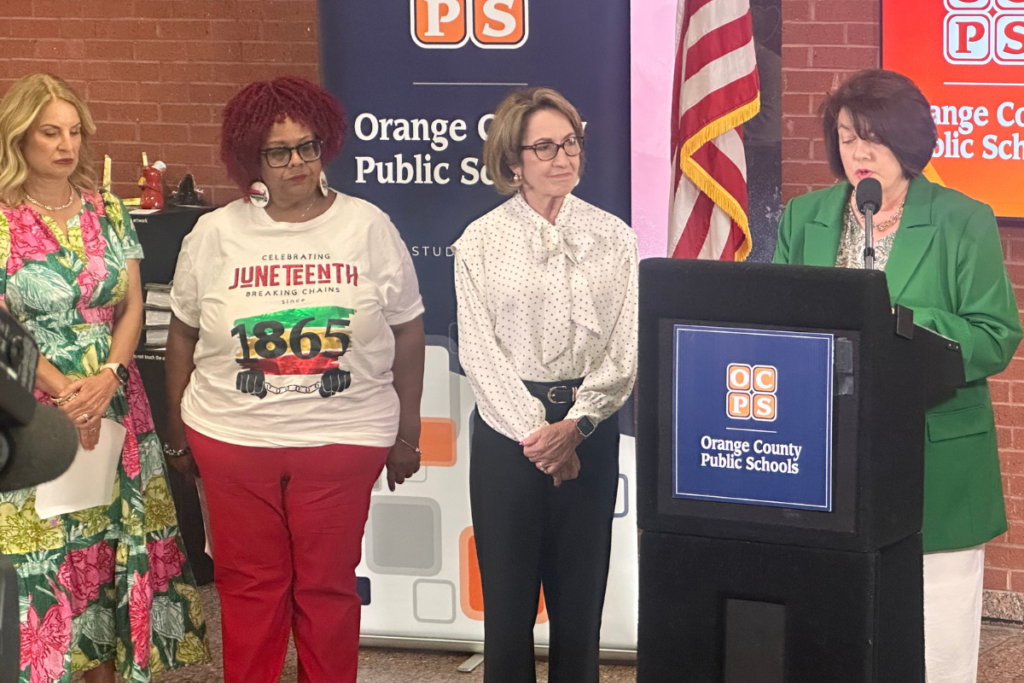
During a news conference at the Ronald Blocker Educational Leadership Center, Superintendent Maria Vazquez said the district remains financially stable and is on track to earn its third consecutive A district grade. However, she warned that the current employee healthcare plan is becoming increasingly difficult to sustain.
“Florida is experiencing some of the fastest increases in healthcare costs in the country, creating real pressure on our system to keep up,” Vazquez said.
OCPS currently contributes up to $10,555 per employee toward healthcare coverage and plans to increase that amount to $11,611 next year, according to district officials.
Vazquez added that, because OCPS is self-insured, maintaining the existing employee health plan without changes would demand an additional $145 million over the next two years on top of the roughly $240 million the district already contributes.
“We’ve invested hundreds of millions of dollars to offset rising healthcare costs, but the reality is that our current plan cannot be sustained, even with $240 million in district contributions,” Vazquez said.
District leaders also discussed ongoing negotiations with employee unions. OCPS declared an impasse in April after what officials described as extended negotiations with the Classroom Teachers Association and Orange School Bus Association. The district characterized the move as a procedural step under Florida law rather than a breakdown in talks.
“I want to be clear, this was not an adversarial step,” Vazquez said. “It’s a responsible and necessary process under Florida law to keep moving forward as deadlines approach related to healthcare decisions.”
Without an agreement, the district could be required to spend as much as $20 million per month to maintain its current healthcare plan, according to Vazquez. She said that level of spending would leave less money available for teacher raises, classroom support and student programs.
The district and unions are scheduled to meet with a magistrate July 9-10 as part of the impasse process.
School Board Chair Teresa Jacobs said OCPS is also grappling with broader funding challenges despite receiving a slight increase in state education funding this year.
“The cost of educating students is rising faster than the revenue available to support them,” Jacobs said.
Jacobs and other board members highlighted the importance of the district’s one-mill property tax referendum, which will appear on the Nov. 3 ballot for renewal. The voter-approved tax has been in place for more than 15 years and currently funds approximately 2,000 positions, including teachers, counselors and other school employees.
“It helps support 2,000 positions and a 16% increase in employee compensation over three years,” Jacobs said.
School Board Member Melissa Byrd, representing District 7, which includes the Apopka area, said roughly 90% of the revenue generated by the referendum supports compensation for teachers and educational support staff.
“I would also like to emphasize the healthcare costs that are quickly rising,” Byrd said. “Ignoring these pressures is not an option. Doing nothing only makes the problem worse and will cost us money available for raises.”
District officials said they remain focused on protecting classroom instruction and employee benefits while developing a long-term strategy to address enrollment declines, rising costs and future financial challenges.
Author
Suggested Articles
No related articles found.