



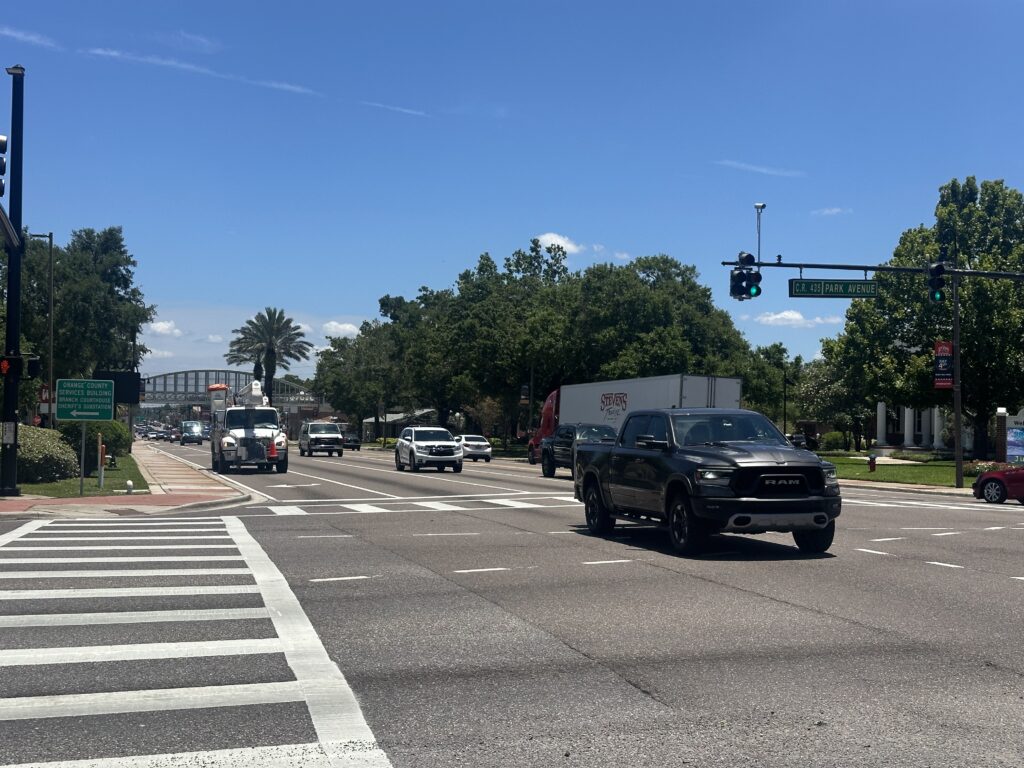
File photo
Key Points
- The Florida Department of Transportation awarded the city the FLASH Award for its rapid response to a dangerous signal failure at the U.S. 441/Park Avenue intersection.
- City staff promptly assessed and repaired corroded mast arms from Feb. 9 to Feb. 13, maintaining signal operations with temporary measures.
- FDOT plans a full rebuild of the intersection's signal infrastructure as part of its long-term work plan after the emergency repairs.
The Florida Department of Transportation (FDOT) District 5 has awarded Apopka the FLASH Award for its rapid response to a dangerous signal failure at one of the city’s busiest intersections.
FDOT Traffic Operations Manager Tricia Ballard presented the recognition during the City Commission meeting on Wednesday, honoring public works and police personnel for their coordinated efforts at U.S. 441 and Park Avenue.
“This was somewhat an unprecedented event. You don’t get too many intersections where mast arms were corroded [and] had to be taken down immediately,” Ballard said, noting the city “stepped up to the challenge” and responded quickly to ensure public safety.
As part of the recognition, certificates were presented to several city staff members, including Police Chief Lovetta Quinn-Henry, police officer Daniel Colley, public works director/city engineer Vladimir Simonovski, streets and drainage manager Michael Ortiz, and traffic operations technician Juan Montealegre.
The award recognizes agencies that demonstrate exceptional response to signal emergencies, such as structural failures requiring immediate action. In this case, FDOT identified severe corrosion and section loss at all four mast-arm bases at the intersection in a Dec. 18, 2025, report, prompting urgent action.
City staff responded the same day, assessing the site and working with FDOT to develop a plan. Their responsibilities included coordinating maintenance-of-traffic plans, establishing detours, managing lane closures and assisting with public notifications – efforts FDOT officials said were critical given the intersection’s prominence in downtown Apopka.
A repair plan was approved Jan. 20, and work began Feb. 9 with overnight operations to limit disruptions. By Feb. 13, crews had removed the mast arms and completed repairs. A temporary wood-pole diagonal span was installed to maintain signal operations, and by Feb. 16, detection systems were converted to radar to align with the interim setup.
According to Ballard, the situation required extensive coordination due to underground utilities, traffic flow and visibility considerations. The city’s familiarity with local roads played a key role in developing effective detour routes and minimizing impacts to motorists.
The FDOT is now programming a full rebuild of the intersection’s signal infrastructure as part of its long-term work plan, Ballard said.
Author
Suggested Articles
No related articles found.