



Teresa Sargeant
Key Points
- In 1776, while the Continental Congress declared independence, Florida's Lake Apopka area was wilderness governed by Britain as East Florida.
- Seminole leader Coacoochee, born near Apopka, played a key role in the area's history during the Seminole Wars in the early 19th century.
- Apopka's community formed post-Civil War, with African American landowner Sarah Mead helping establish Mead's Bottom near today's city center.
In the summer of 1776, delegates in Philadelphia debated independence from Great Britain. On July 4, the Continental Congress adopted the Declaration of Independence, launching a revolution that would ultimately reshape North America and the future United States.
More than 800 miles away, however, the shores of Lake Apopka were worlds apart from the revolutionary fervor sweeping the colonies.
Today, many residents know Apopka as one of Central Florida’s fastest-growing cities. But Justin Baker, museum technician at the Apopka Museum, said the community once rivaled what would become Orlando as a regional center.
“We were the central hub of Orange County, essentially,” he said.
Florida was not one of the 13 colonies, but remained a British territory known as East Florida, governed from St. Augustine. While revolutionaries fought for independence to the north, East Florida stayed loyal to King George III and became both a military outpost and a refuge for thousands of Loyalists fleeing the war.
Far inland from the colonial conflict, the landscape around Lake Apopka was shaped not by politics but by nature. Wetlands, pine forests, oak hammocks and open prairies defined the wilderness that surrounded one of Florida’s largest lakes.
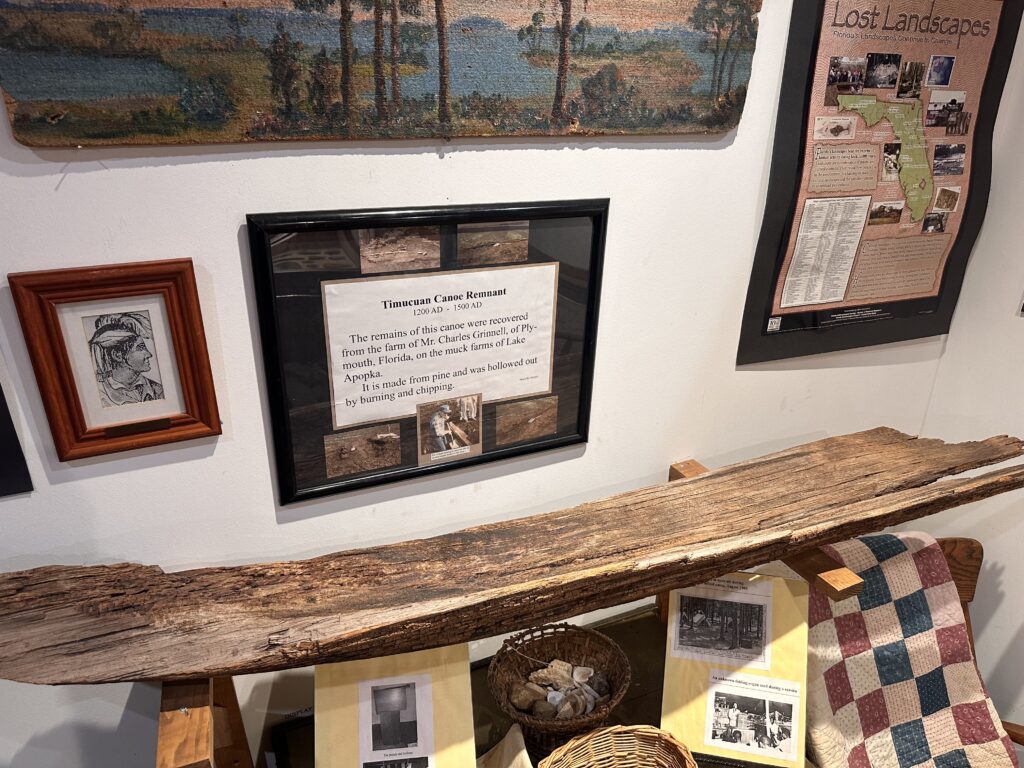
For generations, Indigenous peoples such as the Acuera, part of the Timucua cultural group, lived around Lake Apopka long before European settlement. “Apopka” derives from a Native word associated with potatoes, reflecting the area’s long agricultural heritage and Indigenous roots.
“There was not really much of a community as we would know it today,” Baker said. “It was mainly the indigenous people that were in the areas, as well as probably some pockets of the Spanish were in the area.”
By the late 1700s, Seminole communities had established villages in the region, relying on the same abundant resources that had sustained earlier inhabitants.
The American Revolution ended in 1783, but it would be decades before the changes it unleashed reached Central Florida. That same year, Florida returned to Spanish control. In 1821, Spain ceded the territory to the United States, opening a new chapter in Florida history.
For the Seminoles, American rule brought increasing pressure and conflict. Between 1817 and 1858, three Seminole Wars were fought as the federal government sought to remove Native peoples from their lands. The Second Seminole War became one of the longest and costliest conflicts fought by the United States against Native Americans.
Among the war’s most influential leaders was Coacoochee, known as Wild Cat, a Seminole chief born near Ahapopka. Revered for his leadership and determination, Coacoochee remains one of the most important historical figures connected to the Apopka area.
Baker said Coacoochee’s leadership and the history of his tribe are central to understanding the origins of the Apopka area.
“It was because of his tribe in itself in the area that we even know that this place existed,” Baker said.
As the conflict subsided, settlers began moving into the Lake Apopka region. The Armed Occupation Act of 1842 encouraged pioneers to establish homes and farms in Florida’s interior, and families were drawn by fertile soil, abundant water and a favorable climate. Three years later, Florida became the nation’s 27th state.
Communities gradually emerged around the lake. Among the most significant was Mead’s Bottom, established after the Civil War and located near the site of today’s Apopka City Center.
Named for Sarah Mead, a formerly enslaved woman who helped newly freed families establish themselves in the area, the settlement became home to many of Apopka’s earliest Black residents.
Baker noted that Mead was a landowner at a time when opportunities for African Americans, particularly women, were severely limited.
“We’re talking about an African American individual that owned land in the area and was also distributing it out to other people,” Baker said. “This was very, very influential person, at least within the scope of Apopka. We have deeds, as well, with her name on it.”
As the population grew, community institutions began to emerge. Among the most enduring was the Apopka Masonic Lodge (Orange Lodge No. 36 F & AM), established in 1857. The lodge — predating Apopka’s incorporation by 25 years — became a gathering place for many of the area’s early settlers and played a central role in the development of the community.
By 1882, the town of Apopka City was officially incorporated and later reincorporated as the city of Apopka in the early 1900s.
The America born in 1776 did not arrive in Apopka overnight. Its influence unfolded over generations through territorial expansion, conflict, migration and settlement. Yet the decisions made in Philadelphia that summer ultimately helped shape the community that stands along the shores of Lake Apopka today.
This story was compiled using records from History.com, Florida Humanities, Florida Department of State, the Apopka Historical Society and Museum, and other historical sources.
Author
Suggested Articles
No related articles found.