



Dana O'Connor
Key Points
- The Apopka Museum has a new flagpole thanks to the efforts of a local Boy Scout whose nearly two-year project culminated in a dedication ceremony Saturday morning.
- Charles Phelps led fundraising and volunteer efforts for nearly two years to install a new $1,400 aluminum flagpole with a solar-powered light at Apopka Museum.
- Only 4% of Scouts reach Eagle rank due to the magnitude of required service projects, which demand extensive planning and leadership.
The Apopka Museum has a new flagpole thanks to the efforts of a local Boy Scout whose nearly two-year project culminated in a dedication ceremony Saturday morning.
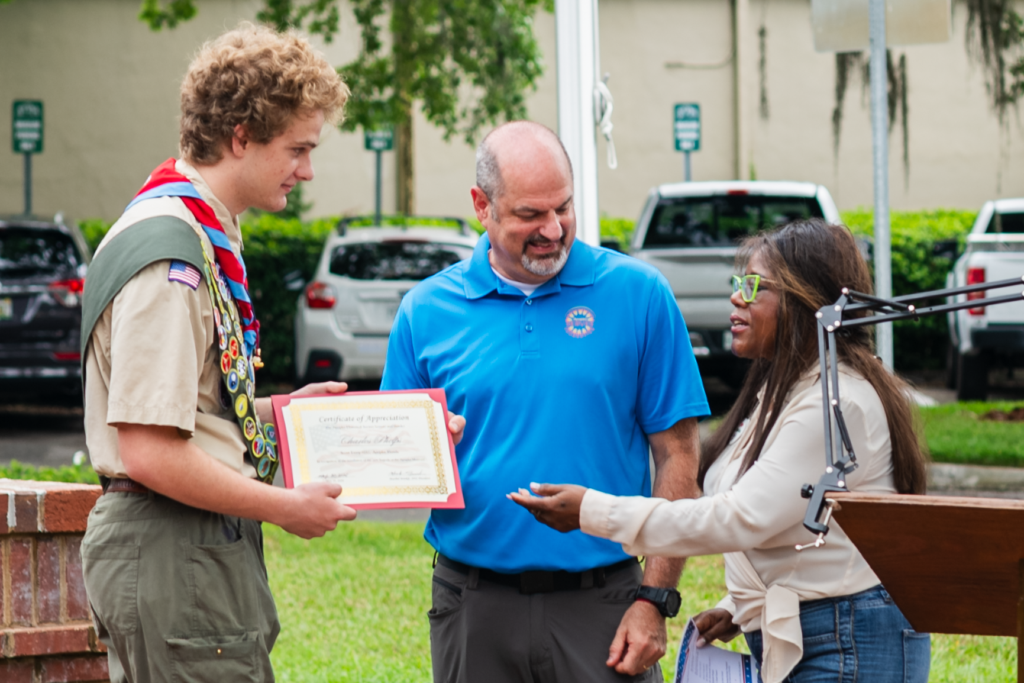
Community members, city officials, members of Troop 211 and representatives of the Apopka Historical Society gathered Saturday at the museum on East Fifth Street to celebrate the installation of the new flagpole and recognize Eagle Scout candidate Charles Phelps, who led the project.
During the ceremony, Phelps recounted how the project began nearly two years ago when his scoutmaster suggested he consider replacing the museum’s aging flagpole.
At the time, Phelps said he was only 13 years old and had not seriously begun thinking about an Eagle Scout project.
When he visited the museum for the first time, however, he immediately saw a need he believed he could help address.
“The first thing I saw was a broken flagpole,” Phelps said. “It couldn’t go up anymore. The second thing I noticed was this bell, all rusted up. Those two things really upset me because this is a museum that represents not only Apopka’s history but our history of Florida and U.S. history.”
The project involved fundraising, planning, organizing volunteers and coordinating multiple workdays. The new aluminum flagpole, which includes a solar-powered light so the flag can remain displayed at night in accordance with the U.S. flag code, replaced the deteriorated structure. Phelps and fellow Scouts also restored the museum’s historic bell by cleaning, painting and repairing its base.
Maribel Brinkle, president of the Apopka Historical Society, welcomed attendees to the ceremony and praised Phelps’ dedication.
The ceremony included an invocation, presentation of the colors by Troop 211, the Pledge of Allegiance and the national anthem before speakers highlighted the significance of Scouting and community service.
Following the ceremony, Phelps said fundraising proved to be the most difficult aspect of the project.
“The flagpole alone was $1,400 with shipping, and there was other stuff still to do,” he said.
The experience taught him valuable lessons about leadership and perseverance. Phelps said the project required “a lot of planning and a lot of effort” and the help of many people.
Brinkle said Phelps’ commitment left a lasting impression on the Historical Society.
“His perseverance, his leadership, how he took two years for somebody this young to keep going and never stop is a lesson,” Brinkle said.
She added that the project represents both community pride and the importance of passing local history to younger generations.
Brinkle said the project showed that younger generations are following in the footsteps of the volunteers who have sustained the museum for decades.
In addition to installing the flagpole, Phelps and fellow Scouts restored the museum’s historic bell by cleaning, repainting and reinforcing its base, according to Brinkle.
Chris Smith, assistant scoutmaster for Troop 211, explained that only a small percentage of Scouts ultimately attain the rank of Eagle Scout.
“The reason why only 4% of Scouts throughout the course of their scouting career will make it to the rank of Eagle is because they have to do a service project of magnitude,” Smith said.
Smith said the Eagle Scout service project requirement appears simple on paper, but completing a successful project requires extensive planning, fundraising, organization and leadership. He cited other examples of Eagle Scout projects that were built in recent years in the community: the Dream Lake Bridge, the 9/11 Memorial outside City Hall and the Edgewood-Greenwood Cemetery gazebo.
“Scouting teaches servant leadership is the most important thing that we can give to a community,” Smith said.
Mayor Nick Nesta commended Phelps and Troop 211 for their service, and thanked Troop 211 for demonstrating servant leadership and strengthening the community.
“Our future is truly bright because of our youth,” he said.
For Phelps, the project’s greatest reward will come years from now.
“I’ll probably be really proud about how I volunteered and stepped up to do that project,” he said.
Author
Suggested Articles
No related articles found.