


Photo by Sarah Merly
Key Points
- The 11th Annual UF/IFAS Florida Agricultural Policy Outlook Conference was hosted by the Mid-Florida Research and Education Center in Apopka.
- Florida's agtech industry has a $77 billion GDP and is projected to add 40,000 jobs by 2028 according to the Florida Department of Commerce.
- The Farm, Food, and National Security Act of 2026 includes $30 million for mechanization and automation research.
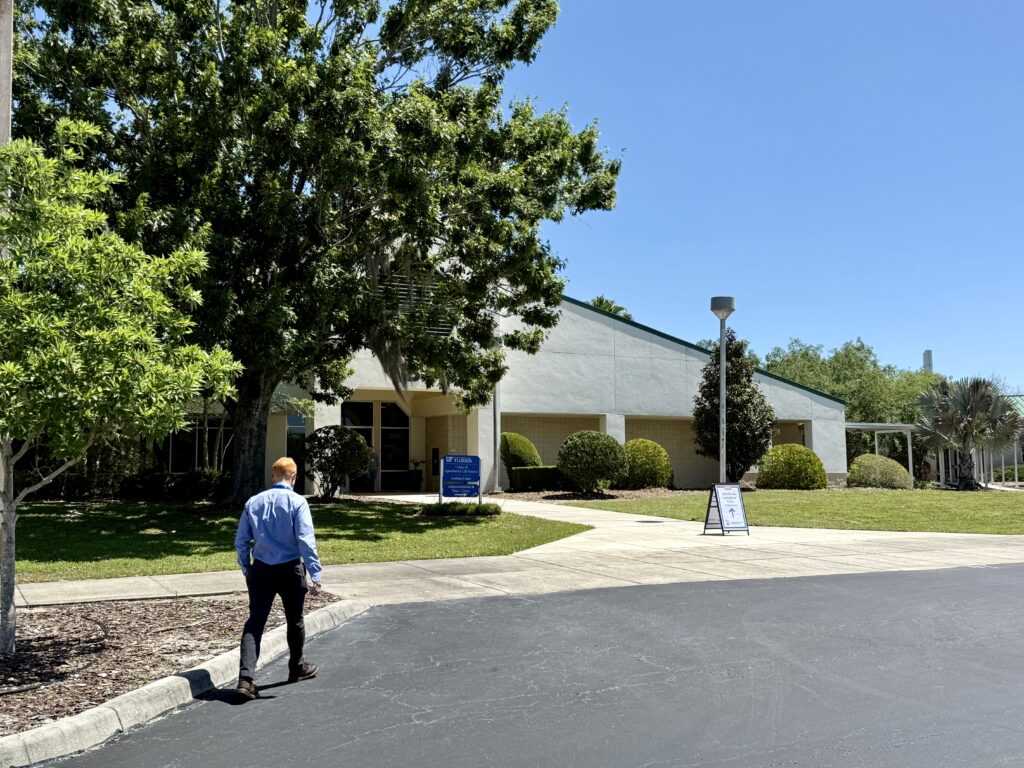
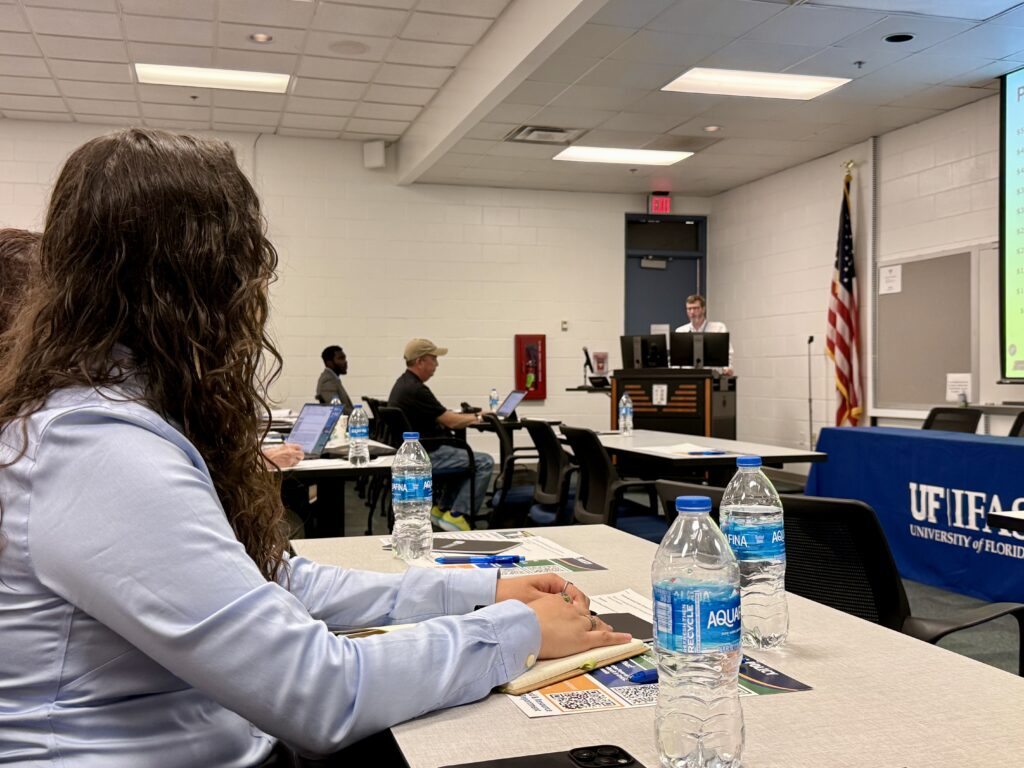
The Mid-Florida Research and Education Center (MREC) hosted the 11th Annual UF/IFAS Florida Agricultural Policy Outlook Conference on Thursday, drawing several dozens of guests from across the state.
“We are especially proud that for over a decade the annual Florida Agricultural Policy Outlook Conference has been a key avenue for sharing information with not only policymakers, but members of the agricultural industry, equipping them with the information needed to advocate for the needs of their industries and communities,” said Lisa House, chair of the UF/IFAS Department of Food and Resource Economics (FRE), in an April 3 press release.
The schedule included sessions on federal and state policy, international trade and the relationship between AI and agriculture. Between sessions, guests could view UF student and faculty posters, which discussed topics ranging from saline hydroponics to agricultural conservation easements.
John Walt Boatright, director of government affairs for the American Farm Bureau Federation, discussed the record-setting rise in costs for farmers.
“Production cost and input cost increases have been a major focal point over the past couple of years, where we see nearly $500 billion, which is a record from 2000 to 2026 that has just been extraordinary,” Boatright said.
Boatwright credited the One Big Beautiful Bill Act as a step toward remedying the situation, despite not solving the problem on its own.
“You see overall estimated change — $65 billion in new investments — through this One Big Beautiful Bill Act,” Boatwright said. “However, it was not a normal farm bill process. They only chose to include certain aspects of the farm bill, and a lot of that were title and safety net changes.”
As a result, Boatwright emphasized the necessity of the Farm, Food, and National Security Act of 2026, or H.R. 7567, introduced in the U.S. House of Representatives on Feb. 13.
“What we believe is very valuable and important in the context of this proposal for the House Ag proposal for Florida — we see a lot of special crop research initiative enhancements in this bill, and of that, there’s a $30 million carve-out for mechanization and automation research,” Boatwright said. “We see continued citrus disease research funding, which is so incredibly important to all of us here in the room, as we’ve all fought hard for continued funding to help with our citrus greening pressures.”
Jason Mahon, deputy secretary for the Florida Department of Commerce, expressed particular optimism for Florida’s agricultural technology (agtech), noting its new inclusion as a “target industry” in the department’s target industry report. According to the report, Florida’s agtech industry has a GDP of $77 billion and an average wage of $128,862.
“The agtech industry met the criteria that we needed to see to say that this has high impact. This is something that we want to support and be involved in,” Mahon said. “By 2028, we’re forecasting that we’ll have another…about 40,000 jobs in agtech in Florida.”
Mahon said that the Florida Department of Commerce’s goal is to increase in-state production of agricultural innovations.
“Ultimately, we see a lot of these companies are producing really great products, like the collars that are going on cows to measure the temperature and what’s going on in the dairy operation,” Mahon said. “But that collar is not made here — it wasn’t created here. And we really want for more companies to say, ‘Hey, I want to have a technological breakthrough, and I want to produce that in the state.’”
Mahon then commended the innovations arising out of UF/IFAS, which MREC director and professor Kirsten Pelz-Stelinski further commented upon after Mahon’s session.
“We’re really interested in continuing that support for the ornamental greenhouse industry, but also expanding more into protected and controlled environment agricultural systems and automated plant productions, as well as developing more urban agriculture,” Pelz-Stelinski said. “We are very unique in that we’re located right by Orlando, and so this offers us an opportunity to sort of partner and become part of that new footprint of maybe smaller focus commercial agriculture and also thinking about space-based agriculture, because of our location really close to Cape Canaveral.”
The MREC, located at 2725 S. Binion Rd., offers degree programs in geomatics and plant science and contains approximately 30,000 square feet of greenhouse space, according to Pelz-Stelinski.
Author
Suggested Articles
No related articles found.