


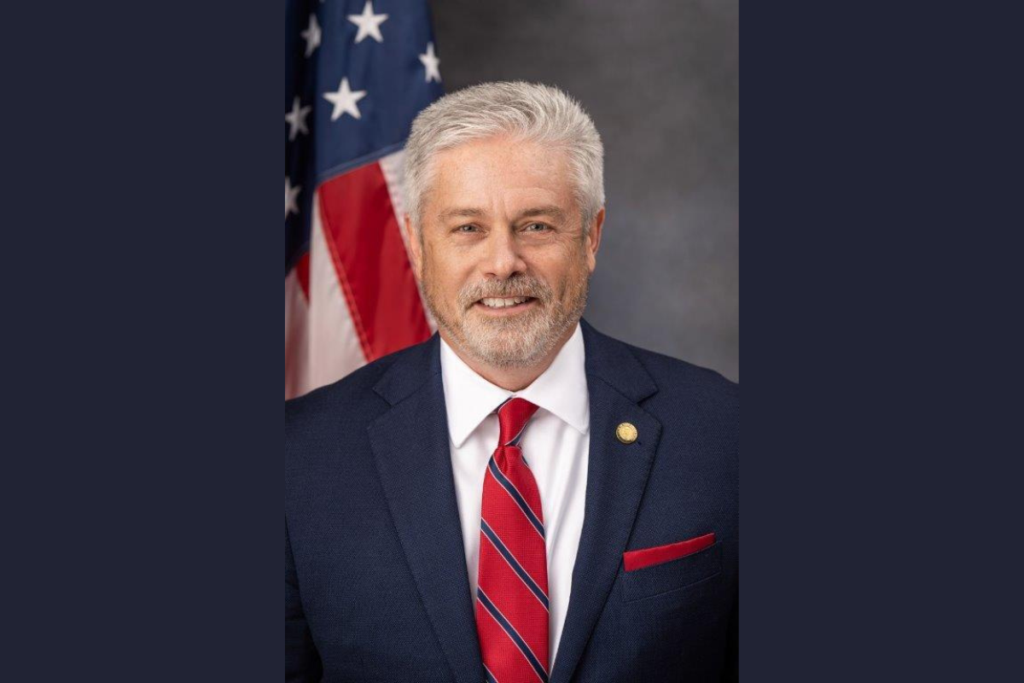
Official photo
Key Points
Florida’s progress with regulating artificial intelligence (AI) in education hit a milestone last month, when the State Board of Education adopted new rules placing strict guardrails on use in K-12 schools and colleges. These rules, described by the Florida Department of Education as one of the nation’s most comprehensive, parent-centered AI frameworks, aim to ban companion AI tools, protect student data, and give parents a say over their child’s classroom use.
Gov. DeSantis supported the measure, stating that “Florida will not outsource childhood to a chatbot. … We welcome tools that help teachers teach and students learn. … In this state, a teacher stands in front of the class, a parent has the last word, and a student still has to think.” (Source: WJXT News4JAX; FDOE)
The adopted rules apply to school districts, charter school boards, and Florida College System institutions. While the rules do not ban AI technology use in classrooms, they do position it to support teachers and parents.
The rules for school districts and charter schools require that parents be notified when an AI instructional tool is approved for instructional use, including the name of the tool, which grades and subjects it will be used in, and the level of student interaction. For direct student use, parents are given the option to opttheir child in or select a non-AI alternative of comparable instructional quality and access.
AI tools used in voluntary prekindergarten through fifth grade undergo additional review for age and developmental appropriateness. Teachers and administrators must undergo training on the risks and limitations of AI.
Students in K through 12 will not be permitted to use autonomous or agentic AI unsupervised. School districts and charter school boards are required to adopt and implement their policies by July 1, 2027, for the 2027-28 school year.
State colleges are required to provide limitations on AI use, specifically for work on graded assignments or assessments (subject to the course instructor’s approval).
The rules also provide protections for students from AI technologies designed to simulate companionship or emotional relationships, monitor behavior without disclosure, and provide vendors with a vehicle to collect and sell student data.
The idea that such technology can be used to provide advice on topics such as interpretations of the Bible or suicide is very troubling to me. Though AI can provide information, it cannot provide the emotional support in the same way another human being can.
Having this guardrail in place for the classroom puts me at ease for the next generation. It also gives me hope that student privacy is protected from vendors seeking to collect and sell data and protects their ability to think critically—our kids are NOT for sale.
Florida Commissioner of Education Henry Mack tasked the Florida Department of Education with updating the K-12 computer science standards and Florida Digital Classrooms Plan, which will require school districts to evaluate AI technology according to learning outcomes (not screen time) and to prove its instructional value before purchasing or renewing these tools.
While AI isn’t going anywhere, I believe that we have the proper guardrails to enhance classroom instruction while keeping our kids safe and preparing them for the future.
This issue was a policy priority for me this past legislative session, when, as vice chair of the Student Academic Success Subcommittee, I worked with the chair and experts on how to bridge the gap between beneficial AI usage and guardrails to protect our children.
I commend Gov. DeSantis and Commissioner Mack for their balanced approach to innovation and child internet safety. It’s these conservative, forward-thinking approaches that help keep Florida leading the way.