



Patsy Whitely-Beckett
Key Points
- Skip Strohm grew up on Long Island and watched the Twin Towers rise during visits to Manhattan with his father in the late 1960s and 1970s.
- On Sept. 11, 2001, Strohm saw the attacks unfold on TV while getting a haircut in Apopka, realizing the event was a planned act of war.
- Two months after 9/11, Strohm saw abandoned cars at a New City train station, which he realized belonged to commuters who never returned from the attacks.
For Skip Strohm, memories of the World Trade Center stretch back decades before the morning the Twin Towers fell.
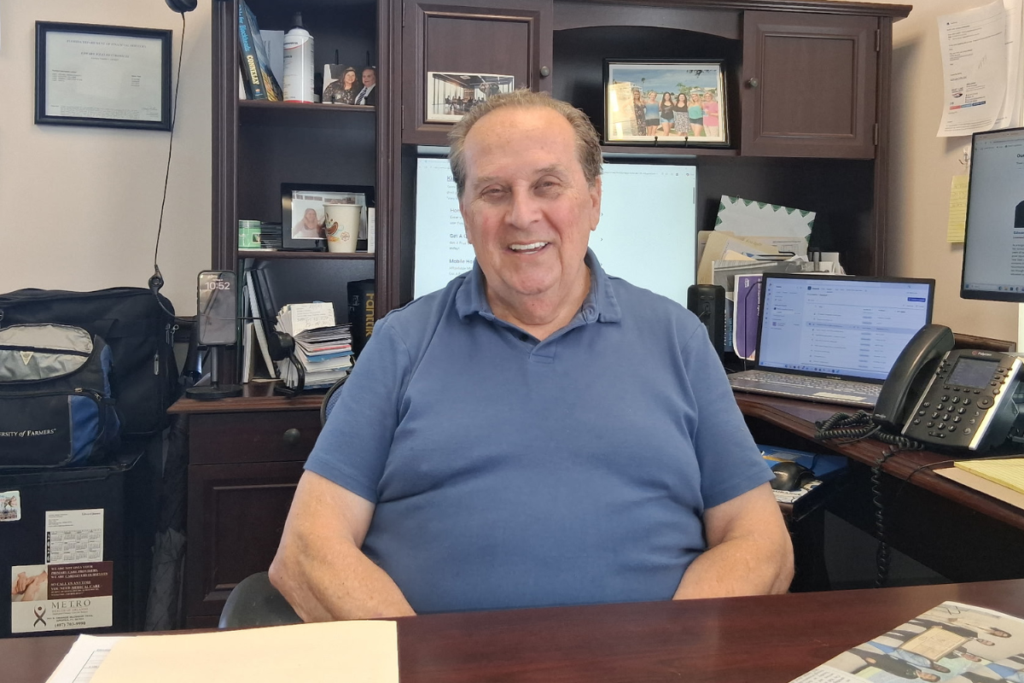
Strohm, owner of Strohm Insurance in Apopka, grew up on Long Island and remembers traveling into Manhattan with his father during the years the towers were being built.
His father, who worked aboard tankers and periodically returned to an office in downtown Manhattan, sometimes brought Strohm along. During trips into the city from the late 1960s into the 1970s, Strohm watched the towers steadily rise.
“You’d see it being built,” Strohm said. “Every couple of months you’d go by — ‘Oh, look how much further they are.’” He recalled watching the towers progress from about 10 stories to 50 and eventually 100.
Designed by architect Minoru Yamasaki, the 110-story Twin Towers anchored the World Trade Center complex in Lower Manhattan, which was developed as a center for international trade and business. The North Tower rose 1,368 feet and the South Tower 1,362 feet. The complex was dedicated in April 1973, and the towers briefly held the distinction of being the tallest buildings in the world. By 2001, the World Trade Center was home to more than 430 businesses from 28 countries.
By Sept. 11, 2001, Strohm was living in the Apopka area. That morning, he had stopped for a haircut when someone came in and told those inside to turn on the television because an airplane had struck one of the towers.
Strohm initially thought it might have been a small private aircraft. Then he saw the extent of the damage and watched on television as the second plane struck.
“The first thought that came through my head was, ‘We’re at war,’” Strohm said. “This is planned.”
Strohm said he probably followed the extensive news coverage more closely because he had grown up in the area. But one of his most vivid memories came about two months later, when he returned to New York to visit friends.
While visiting friends in New City, New York, Strohm drove past a train station and noticed about 20 to 25 dirt-covered cars still sitting in the parking lot.
Then he realized why they were there.
“It dawns on you — these are people that commuted to work and didn’t come back,” Strohm said.
Seeing the abandoned vehicles was “like a punch in the stomach,” he said.
Strohm left New York as a teenager to attend school in Connecticut and later Pennsylvania before settling in Florida after college. Despite his New York roots, he said he no longer thinks of himself as a native New Yorker after spending most of his adult life in Florida.
As the nation marks the 25th anniversary of the Sept. 11 attacks, Strohm said the passage of time itself is striking.
“Can’t believe it’s 25 years already,” he said.
Patsy Whitely-Beckett contributed to this report.
Author
Suggested Articles
No related articles found.