



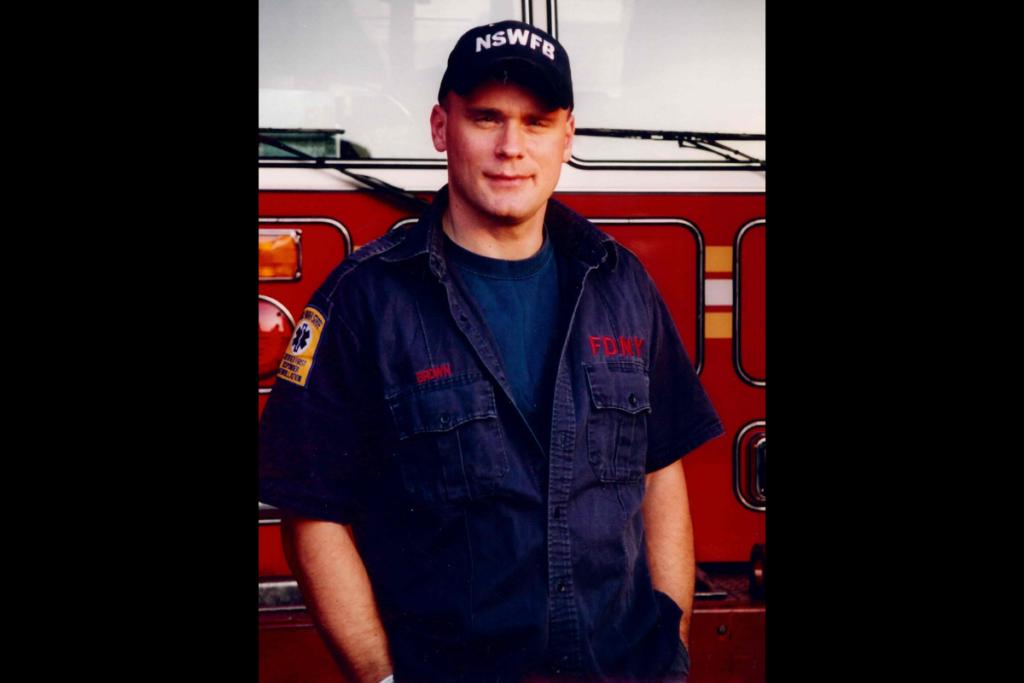
Courtesy of Jimmy Brown
Key Points
- Jimmy Brown, a probationary FDNY firefighter, survived the 9/11 attack while responding inside the North Tower and helped evacuate civilians before its collapse.
- Brown suffered PTSD and initially stopped working but returned to firefighting, later moving to Orange County Sheriff's Office after retiring from FDNY.
- He wrote a detailed 9/11 account in 2011 to preserve memories for his children and to honor fallen colleagues from his academy class.
The morning began with coffee, a newspaper and the ordinary routines of a New York City firehouse.
Jimmy Brown was a probationary firefighter assigned to Engine 10/Ladder 10 in Lower Manhattan, about 10 weeks into a 14-week training rotation. He had returned from an early-morning call for a transformer fire and was preparing for the 9 a.m. roll call when an unfamiliar sound cut through the morning.
An airplane was flying low over Manhattan.
At 8:46 a.m. on Sept. 11, 2001, Brown heard the aircraft grow louder as it approached the World Trade Center. Firefighters outside the station began shouting that the plane was going to hit one of the towers.
Seconds later, American Airlines Flight 11 struck the North Tower. Brown felt the impact from the firehouse and watched debris begin falling into the streets.
Twenty-five years later, Brown, now 59 and living in Winter Garden, measures what happened next not only by what he survived, but by everything that came afterward.
“God is good,” Brown said. “I didn’t expect to get one day because I thought I was going to die that day. And come Friday, I will have had 25 years that I shouldn’t have.”
Brown has done the math: 9,131 days. Each, he said, has been “a unique gift.”
“If I didn’t survive that day, my son and my daughter wouldn’t exist,” he said.
Brown had joined the New York City Fire Department after nine years as a New York City police officer. As a probationary firefighter at Tenhouse, as Engine 10/Ladder 10 was known, Brown was in the middle of a 14-week firehouse training rotation and had not yet formally graduated.
On Sept. 11, Brown responded with Engine 10. He and other firefighters entered the North Tower as civilians streamed out. Inside, Brown encountered severely burned victims and extensive damage before he and other firefighters began climbing toward the fire.
During a break about 10 floors up, Brown called his wife, Shirley, telling her he was safe and that firefighters would put out the fire — reassurance that, he later wrote, he did not believe himself.
Around the 23rd floor, the building began to rumble and sway. Brown and the others didn’t know the South Tower had collapsed. Without receiving an evacuation order over their intermittently working radios, Brown and the other members of Engine 10 decided to turn around.
Brown believes that decision saved their lives.
After reaching the lower levels, Brown became separated from his company. Outside the North Tower, he joined other first responders directing civilians away from the complex.
Then the North Tower began collapsing.
Brown took cover near 6 World Trade Center as debris accumulated around him. When it reached his shoulders, he became convinced he would die buried alive. His thoughts turned to Shirley, whom he had married two years earlier. Brown eventually stood and dove through a broken window into 6 World Trade Center.
He survived. But surviving the day didn’t end its impact.
When Brown returned to Tenhouse, firefighters were working 24 hours on and 24 hours off. The company’s normal response area was gone, its fire apparatus destroyed. Instead of responding to fires, Brown returned repeatedly to what had become Ground Zero.
“The only thing that we could do each and every day was to go out into the pile and do whatever tasks they assigned us,” Brown said.
For Brown, who said he was experiencing post-traumatic stress disorder, returning to the site became overwhelming.
“I felt like I was being assaulted for 24 hours every time I went in,” he said.
Brown sought a temporary assignment away from Ground Zero so he could return to the routine of firefighting. When the department couldn’t accommodate the request, Brown said he did not return to work for about a month. During that time, he sought help through a peer-support connection from his years with the New York City Police Department.
Therapy, Brown said, helped him begin bringing “some order to the disarray” in his head. But he didn’t want Sept. 11 to end his firefighting career.
“If I never went back in a firehouse and I never went to another fire, for me, it was the terrorists winning,” Brown said.
Brown later received an assignment to Engine 201 in Brooklyn. Six members of his academy class had died on Sept. 11.
His FDNY career ended several years later because of a shoulder injury suffered while responding to a store fire. After retiring from the FDNY, Brown and his family moved to Winter Garden in 2006. He eventually returned to public safety and now works as a traffic enforcement supervisor with the Orange County Sheriff’s Office.
Jimmy and Shirley Brown now have two children, Andrew and Gabriella, who goes by Gabby. They were also the reason Brown finally committed his memories of Sept. 11 to paper.
He had tried several times to write the account by hand but repeatedly started over. In 2011, during a road trip to New York to retrieve a section of World Trade Center steel for the Winter Garden Fire Department, Brown took a laptop and wrote while he wasn’t driving.
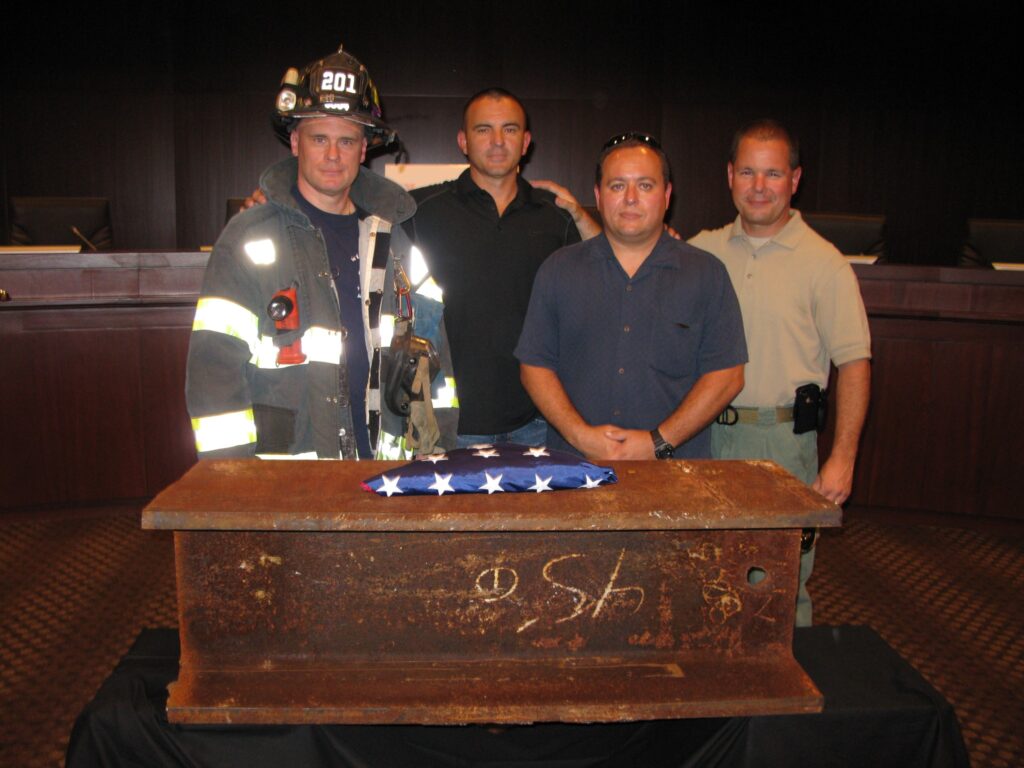
The account was completed shortly before the 10th anniversary of the attacks.
“It was literally — I wrote it for my son and daughter,” Brown said.
Brown said the account is “a way of keeping that day alive” and preserving the memories of people he knew who died.
“Hopefully it outlives me,” he said.
A quarter-century after Sept. 11, an entire generation has grown up without its own memory of that morning.
Brown said there was hope in what followed the attacks, but remembering the history that led to them remains essential.
“If we don’t remember what led up to that day, we’re going to end up there again,” Brown said.
Author
Suggested Articles
No related articles found.