


Screenshot courtesy of FLCA YouTube channel
Key Points
- Apopka currently has no data centers, but more are expected nationwide, often built on rural land with limited public awareness.
- Panelists urged greater transparency on data center construction, with one discussing building them in existing urban areas to preserve rural land.
- Experts warned about AI's risks in schools, calling for parental consent, open-source platforms, and legislative action in Florida.
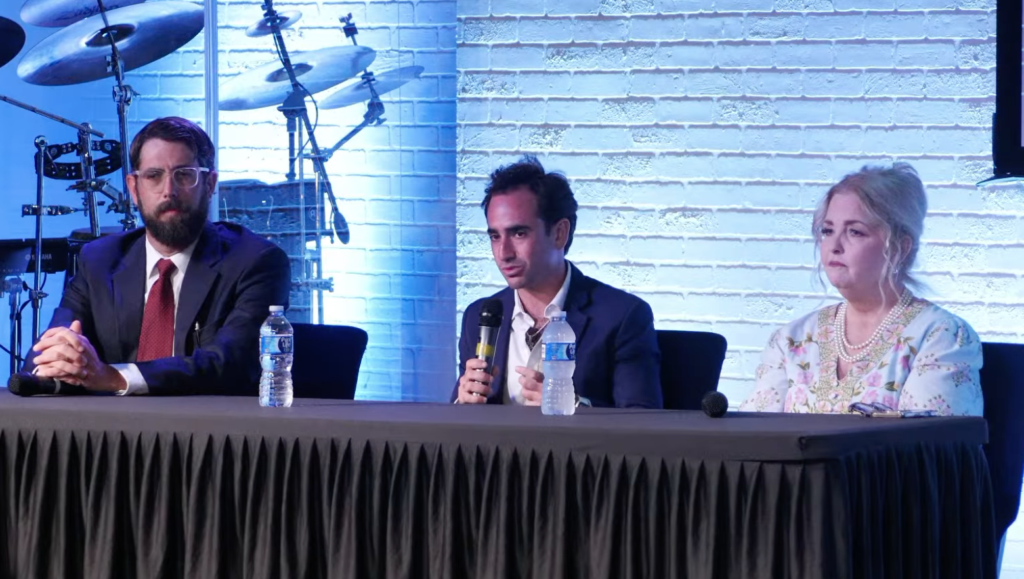
The Florida Citizens Alliance (FLCA) brought five political activists and thinkers to Apopka’s Victory Church on Thursday night, educating guests on data center implications and AI policy.
While Apopka does not currently have a data center in operation, according to datacentermap.com, panelist Sam Romain, chairman of Americans for Energy Dominance, claimed that more data centers are on the horizon nationwide than most may expect.
“The problem with the data center — the way this whole thing works — is that this starts in zoning, and when you read the city or county’s agenda, and it says, ‘We’re going to rezone the northwest quarter of the southwest quarter of Section 42 in Quadrant A3,’ no one knows what that means,” said panelist Sam Romain, chairman of Americans for Energy Dominance. “So there’s very likely way more data centers in process than anyone in this room is even aware of.”
Fellow panelist Tom Gaitens, senior advisor for Humans First, noted that data centers themselves are not new inventions, estimating that the U.S. already has 5,100 to 5,200 centers “we’ve already been using with our cell phone and our computer technology for a long time now.” Instead, Gaitens drew more attention to the rapid obsolescence of regular centers — and possibly of those planned for construction.
“We don’t even know what the half-life of the hyperscale data center is, right? So we have no studies to understand that all this expense, these billions and billions and billions of dollars that we’re funneling — much of it is speculative dollars — and we’re blowing up our 401ks because everyone’s overly invested in this space,” he said.
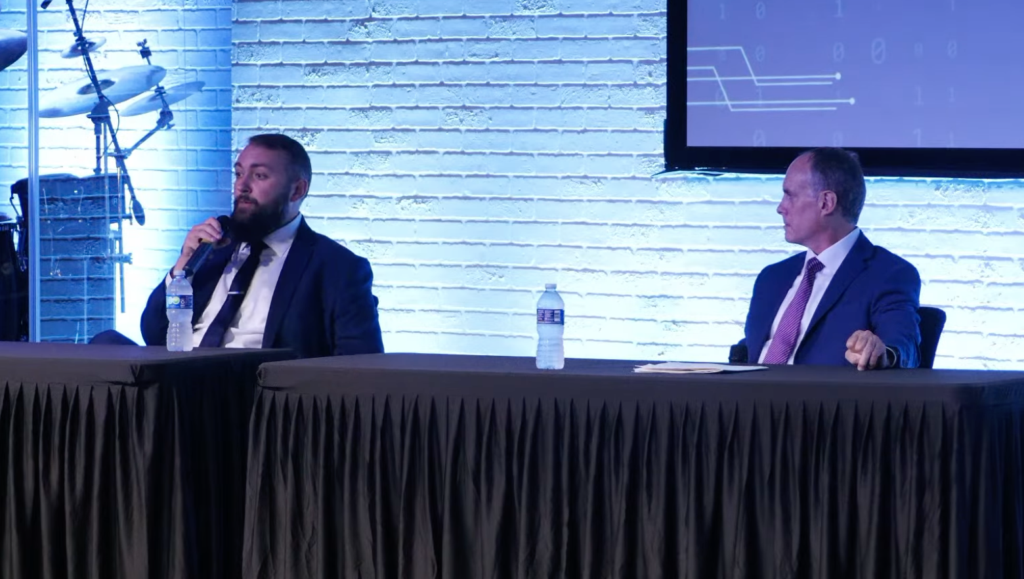
Gaitens also took issue with where data centers are often developed — on rural land — seemingly without much consideration of other options.
“There’s not a lot of competition for political outcomes because there’s fewer people, right? And sothey understand that those are targets that are ripe for exploitation, but the reality is, just like coastland, we are not making more strategic feed-producing land in this world,” he said. “If the only solution they come up with is to destroy rural America, well, I don’t think that’s the only solution.”
Gaitens instead suggested exploring the possibility of building data centers in “dilapidated, outdated parts of the community in the cities,” in “warehouse districts [that] already have electrical capacity programmed into it.”
Romain encouraged guests to give local government officials “grace,” recognizing how much a data center could bring to a city’s economy “on paper.” He drew upon the planned data center in Fort Meade, a city approximately two hours south of Apopka, as an example.
“When you see an opportunity for your city to go from a $1.5 million annual budget — Fort Meade — to a $15 million annual income off of one business that requires 50 parking spaces — and not a whole lot of crime happens at data centers — it’s not a bad deal on paper for them to want to do that, and so that’s why I think [what] these cities are doing is primarily money-driven,” he said.
However, both Romain and Gaitens stressed the need for increased public accessibility to information regarding data center development, with Romain mentioning that nondisclosure agreementsregarding data centers are allowed under SB 484.
“We the people should decide who our neighbors are in the industrial process and how our tax dollars are spent, so that’s why a conservative like myself felt [it] very important to get in this space and help focus people’s attention on the issues,” Gaitens said.
The second half of the symposium focused on the political and educational implications of what the data centers enable: AI.
“It’s one thing to deploy these technologies and make them available to adults who have experience, who have the ability to consent to things,” said panelist Alex Newman, CEO of Liberty Sentinel Media.“It’s an entirely different matter to deploy these technologies with children without parental permission, without parental supervision, and then use them not just to collect endless amounts of data — data so granular, so detailed that I don’t think people can even begin to imagine — but then totake all of that and weaponize it to manipulate these children, to change their attitudes and their values and their mindsets.”
Panelist Amy Kremer, chair of Humans First, pointed to several acts of terrorism on college campusesand beyond enabled by AI, including a shooting in Canada executed by an 18-year-old.
“What’s horrific about that shooting is that conversation with ChatGPT was flagged by 12 people internally at OpenAI, and they took it to their bosses, and nothing was done about it. That shooting could have been stopped,” Kremer said. “The fact that we are talking about the most powerful technology in human history, and there are no reporting guidelines, no transparency guidelines, is unbelievable… So, yes, I’m concerned about our children. I’m also concerned about our national security and how this technology is being used to harm people.”
To start regulating technology in the classroom, Newman suggested implementing parental opt-in and open-source platforms.
“Parents, if they want their children to use any AI in school, should be opting into that technology with what I would consider to be full informed consent,” Newman said. “I think any platforms that are used in schools with children ought to be open-source, so that we can examine the source code closely, make sure they’re not sending the data to who knows who, who knows what government agency.”
Kremer also expressed her support for resurrecting the Artificial Intelligence Bill of Rights, or CS/SB 482, which died in the Florida House of Representatives in March.
“I think Governor DeSantis should call a special session between now and the end of the years, and let’s pass it,” she said. “Governor DeSantis really wanted to get that legislation passed, and unfortunately, your speaker of the house wouldn’t allow it through. Now, your speaker of the house has become an ambassador to Brazil, and he’s no longer there.”
Panelist Alex Dray, national organizing director of Young People’s Alliance, encouraged the audience near the end of the symposium by noting the strong bipartisan support he has witnessed on the legislative front.
“Because of that grassroots concern we’re hearing from all across the country, we’ve been able to successfully turn that concern into real actionable policy that has put important protections and guardrails on this new technology to ensure that it’s good for us and it doesn’t harm us,” said Alex Dray, national organizing director for Young People’s Alliance. “We’ve been able to actually get legislation passed in Nebraska, Washington, and Hawaii on [AI chatbot companions], despite the massive big-tech pressure that we had — Nebraska, red state; Hawaii, Washington, blue states.”
Author
Suggested Articles
No related articles found.