



Patsy Whitely
Key Points
- Tanaine Jenkins, a criminal justice reform advocate, aims to engage local officials and design policy with community input to address issues like parole, occupational licensing and reentry barriers.
- Jenkins plans to discuss new parole system creation in Florida to reduce costs of aging prison population and expand parole eligibility.
- Florida's Senate Bill 752 incentivizes probation compliance by rewarding employment and education with reduced probation days and remote reporting.
A Florida-based criminal justice reform advocate began meeting with Apopka community leaders this week to spark conversations around probation, parole and workforce reentry reform, with the goal of building local support for future state and federal legislation.
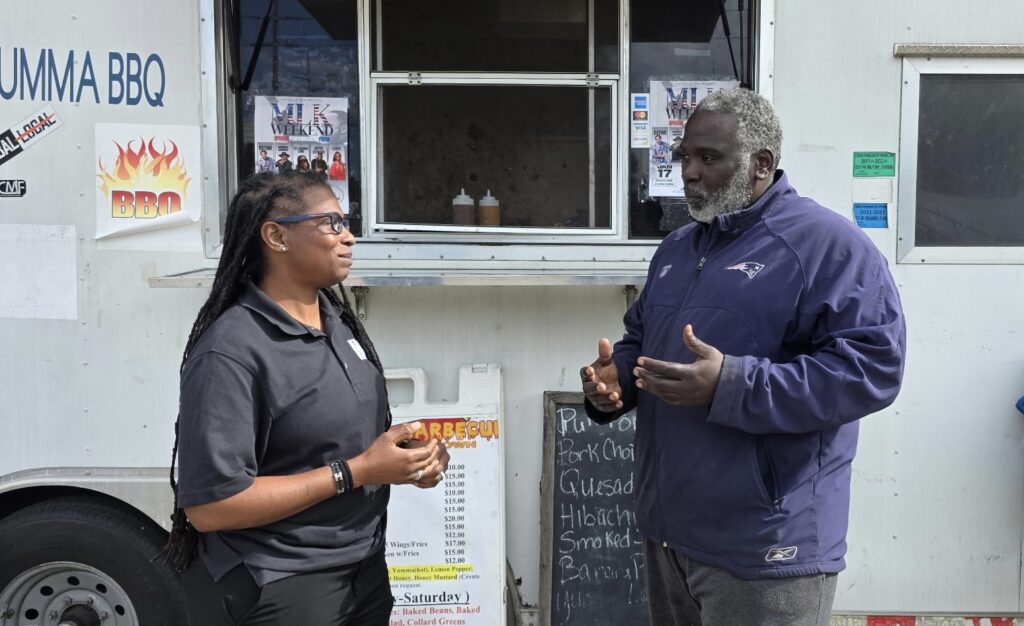
Tanaine Jenkins, state organizer and director for the Florida Safety Coalition, is working with Reform Alliance on probation and parole reform. She said she traveled to Apopka to connect with community leaders as part of a wider effort to reduce barriers for people returning to their communities after incarceration. Reform Alliance is a national nonprofit focused on probation and parole reform.
“I came to Apopka to meet up with Clinton Stanley, because I know he’s one of the pillars in the community that does advocacy,” Jenkins told the Chief in a Thursday interview. “I just wanted to get embedded into the community to see how we can work together and how we can support each other in removing barriers for people to get back to work after they come home from prison or jail, as well as get in with the commissioners and your representative to push the reform and probation and parole agenda.”
Jenkins said she helped pass 22 laws across 12 states over the past six years and is currently working toward federal legislation.
In Florida, she pointed to Senate Bill 752, passed in 2021, as an example of recent reforms aimed at incentivizing compliance for people on probation.
“It’s an incentives bill for those who are on probation,” Jenkins said. “If they maintain a job 30 hours a week or more, every six months they receive 30 days off their probation. If they get any education, they get 60 days off of their probation, and it also allows them to remote report.”
Jenkins pointed to parole reform bills other organizations have promoted and that currently are under consideration by the state Legislature. Only about 3,600 individuals remain eligible under the former system, which was eliminated for most offenses in 1993. She said Florida’s prison population is aging and becoming increasingly costly to taxpayers.
“The prison population is aging, and it’s costing taxpayers 10 times as much to take care of someone over the age of 40 as it would someone under,” Jenkins said. “If we had a parole system in place, then those people would be able to get parole, and basically, taxpayers wouldn’t be paying for their care while they’re in prison.”
According to the Prison Policy Initiative, 157,000 of Florida’s residents are incarcerated in various facilities, including local jails and state and federal prisons.
Each year the state releases over 24,000 incarcerated people with more than 60% rearrested within three years, according to the Florida Policy Project.
Another focus of potential reform is occupational licensing. Jenkins said approximately one-third of jobs in Florida require an occupational license, which often excludes people with prior convictions from employment opportunities.
As part of her visit, Jenkins met with Apopka resident and community advocate Clinton Stanley, whom she described as a key local voice on issues affecting returning citizens. She said her approach centers on listening to residents, rather than proposing predetermined solutions.
“We just want to start the conversation now, so people can understand who we are, what we’re trying to do,” Jenkins said. “We don’t come into a state and say, ‘We think you need this.’ We come into a state and we say, ‘What do you need?’ We ask the question. And last year we did six listening sessions across the state of Florida … just listening to returning citizens, listening to policymakers, listening to probation officers, listening to local elected officials. So we try to listen to people and then create policy around what the actual residents are saying.”
Stanley emphasized the role of local government in supporting grassroots organizations and investing in community resources, particularly for youth and families.
“Local officials really [need to be] getting to the root of the problem, really helping grassroots organizations help reform and change the dynamics of the community, starting with the youth and even with the parents, with resources, giving them job opportunities, skill training, bringing these resources to the community,” Stanley said. “We need the local officials who really buy in and invest into the community. Even when they’re doing development, making sure that developers are also buying in and investing into the community as it’s being gentrified.”
Stanley also said community engagement should be part of development decisions, especially in neighborhoods experiencing redevelopment and rising property values.
Jenkins said she hopes to meet with Apopka city officials including Mayor Bryan Nelson, City Council members and local law enforcement leadership, along with state legislators representing the area.
Although no meetings have been scheduled yet, she said her goal is to begin discussions now in anticipation of possible legislative efforts over the next one to two years.
“With Reform [Alliance], we’re looking at passing policy in the next one or two years, so we just want to start the conversation now so people can understand who we are, what we’re trying to do,” she said.
Jenkins said engaging those most affected by the criminal justice system is essential to crafting effective reform.
“The people closest to the problems are the ones closest to the solution, and that’s why I’m meeting with Clinton to see the problem so we can try to figure out some solution,” she said.
Editor’s note: This story has been updated to clarify that other organizations are promoting state parole reform bills.
Author
Suggested Articles
No related articles found.