



Key Points
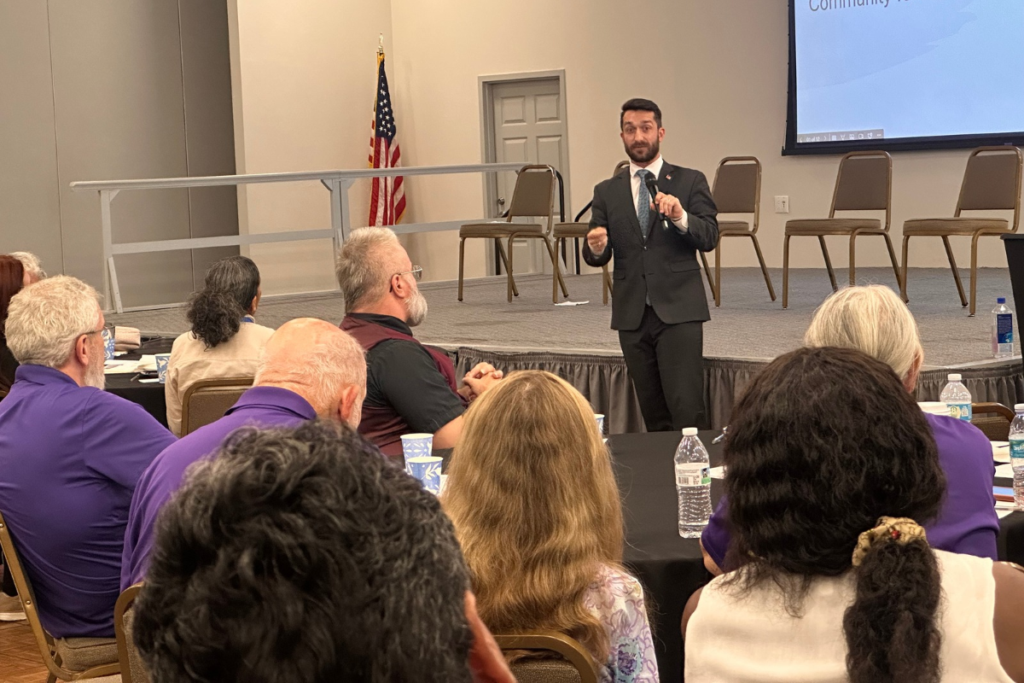
- The Thursday town hall at the Apopka Community Center, where more than 100 people attended, explored job challenges and workforce development efforts.
- Apopka Mayor Nick Nesta reported 98 city job openings and expressed interest in hosting a community-wide job fair to connect employers and employees.
- Hope Community Center plans to form resident-led committees to identify job barriers and propose solutions to Apopka city officials.
Residents seeking better-paying jobs, workforce training and economic opportunities met with Mayor Nick Nesta and community organizers Thursday as Hope Community Center launched an effort to address employment challenges in Apopka.
The “Apopka Works for All” town hall at the Apopka Community Center drew at least 100 people to discuss employment barriers and potential solutions, including a community job fair and workforce development initiatives.
Hope organizers plan to form resident-led committees to identify employment barriers and develop proposals for city officials. Organizers intend to discuss the proposals with the mayor and commissioners before reconvening residents to determine which to pursue.
Nesta said at the town hall the city has 98 part-time and full-time openings, ranging from camp counselors and maintenance workers to construction inspectors, accountants and police officers. The city also offers paid training for certain police and fire department positions, he said.
“We have jobs at all levels,” Nesta said.
The mayor expressed interest in organizing a community-wide job fair involving local employers.
“I think that would be a huge value add, not only to the employers but to the employees as well,” Nesta said.
No date or arrangements were announced.
Shakhea Hinton, Hope Community Center’s director of communications and development, said the organization arranged the town hall because more families were seeking employment assistance. Some worked two or three jobs but still struggled to pay their bills.
“At the basis of all of that, it boiled down to jobs,” Hinton said. “It boiled down to hourly wage.”
Florida’s minimum wage reached $15 an hour on Sept. 30 under Amendment 2, approved by voters in November 2020. The measure raised the wage to $10 in September 2021, followed by annual $1 increases through 2026.
Hope organizing director Ericka Gomez-Tejeda said participants identified healthcare jobs, entrepreneurship and small-business development among their priorities.
“Tonight, the community came together to talk about the kinds of jobs that they would like to have, the kind of training that they would like to get in order to have those jobs,” Gomez-Tejeda said.
She cited a healthcare-focused job fair as one possibility for addressing residents’ employment priorities.
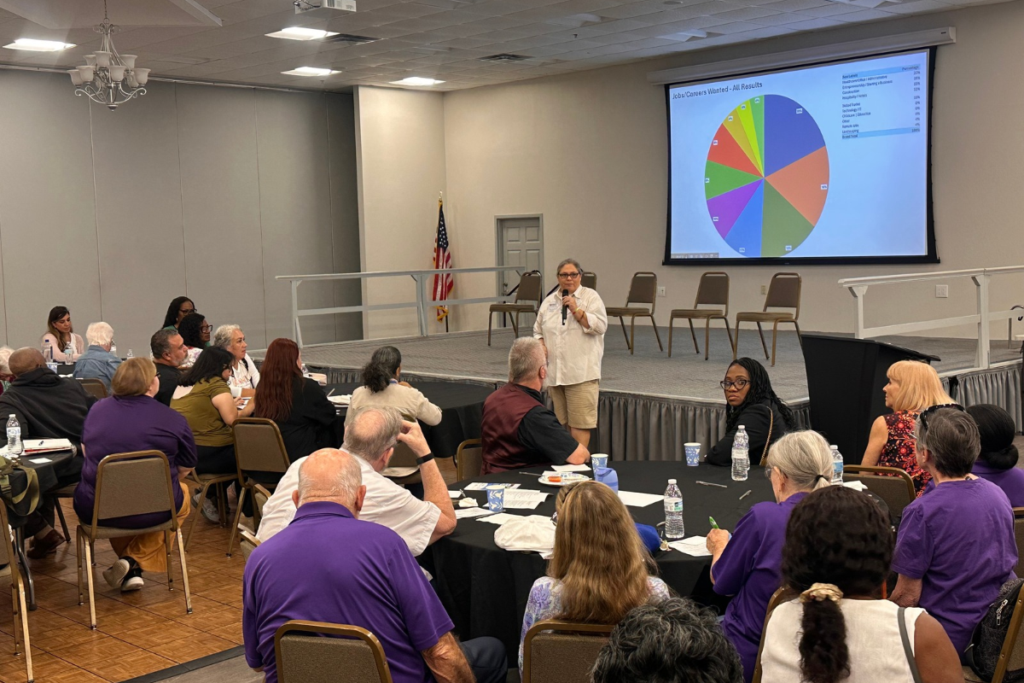
Attendees also questioned Nesta about immigration enforcement, South Apopka annexation, cultural representation, youth involvement and inclusion.
During the audience Q&A, one question Nesta received was about immigration enforcement affecting residents traveling to work and elsewhere. Nesta acknowledged its economic impact but said the city must comply with Florida law.
He said officials were discussing the Apopka Police Department’s agreement under the federal 287(g) program, which allows trained local law enforcement officers to perform certain immigration enforcement duties under federal supervision.
“People are people, regardless of status, and we need to treat people like people,” Nesta said.
Nesta reiterated his support for allowing South Apopka residents to vote on annexation into the city while preserving the unincorporated community’s history and avoiding displacement through gentrification.
Vice Mayor Diane Velazquez said after the town hall that city officials could connect residents with employers, training programs and the Apopka Area Chamber of Commerce.
She identified Amazon, Goya Foods, AdventHealth and Orlando Health as potential employment and training resources, citing their presence in the Apopka area.
Velazquez also noted that South Apopka residents had presented the City Commission with a petition opposing annexation.
“They’re looking for results. That’s what they’re looking for. No more talk. They’re looking for results,” Velazquez said of attendees.
Jeannie Economos of the Farmworker Association of Florida expressed optimism about the diversity of participants but said inclusion requires more than cultural celebrations. Black, Hispanic and Haitian residents also need representation in government decision-making, she said.
Organizers collected residents’ contact information and invited them to participate in the proposed committees. No follow-up meeting dates were announced.