



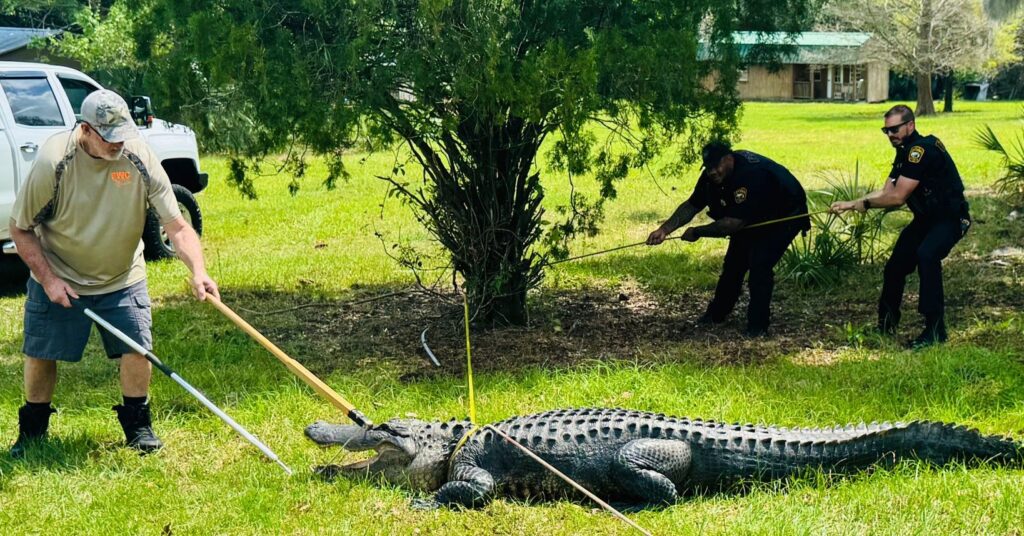
Courtesy of Apopka Police DepartmentPD/Facebook
Key Points
- Apopka police, working alongside a licensed wildlife trapper, captured and relocated a large alligator earlier this week after it was reported near a roadway.
- The Florida Fish and Wildlife Conservation Commission authorizes trappers to remove nuisance alligators over 4 feet in length from populated areas.
- The Apopka Police Department advises residents to keep pets leashed and supervise children near water to prevent alligator encounters.
Apopka police, working alongside a licensed wildlife trapper, captured and relocated a large alligator earlier this week after it was reported near a roadway.
Officers responded Monday to a call about an alligator spotted along Yothers Road, between U.S. Highway 441 and the Chandler Estates subdivision. According to Sgt. Jennifer Rudich of the Apopka Police Department, a caller reported seeing the alligator near the roadway.
Police arrived at the scene and then contacted the Florida Fish and Wildlife Conservation Commission (FWC), which dispatched a licensed nuisance alligator trapper. The trapper captured the animal and relocated it to a safer location, authorities said.
A “nuisance alligator” is a term used by FWC for captures that are at least 4 feet in length and may pose a threat to people, pets or property. Through its Statewide Nuisance Alligator Program, FWC authorizes contracted trappers to remove such alligators from populated or high-traffic areas.
In a public safety message shared on its Facebook page, the Apopka Police Department urged residents to “Stay Alert. Keep Your Distance. Stay Safe.” While “sightings can be alarming,” residents are advised to keep a safe distance from alligators and never attempt to approach or feed them, because doing so can cause the animals to lose their natural fear of humans.
Residents are also encouraged to keep pets on a leash and away from the water’s edge and to closely supervise children near bodies of water.
Florida has about 1.3 million alligators living in all 67 counties, which inhabit all the state’s wild areas that can support them, according to the FWC website.
“Florida has a healthy and stable alligator population,” the website stated, later adding that “the removal of nuisance alligators does not have a significant impact on our state’s alligator population.”
Relocated alligators often try to return, creating risks along the way and making recapture harder, according to the FWC website. Moving them to remote areas isn’t ideal either, as those habitats already have established populations, and introducing a new alligator can trigger fights that may injure or kill either the newcomer or resident animals.
Anyone who encounters a nuisance alligator is advised not to handle it and instead contact the FWC Nuisance Alligator Hotline at 866-392-4286.