


Photo by Rey Villavicencio
Key Points
Wekiva High School has received the university-assisted community school (UACS) designation, unlocking millions in funding to transform the campus into a hub for a variety of student services.
The Full-Service Community Schools Program federal grant awarded UCF $50 million toward its Unlimited Potential Initiative (UPI) grant. UCF then awarded approximately $7 million to community schools within OCPS as part of its UPI grant.
So what is a community school?
“This community school model is more like a strategy that helps boost academic success and strengthen our communities by making that connection so that the schools can be a hub for health and social services, youth programs, family engagement, academics — all those things that kind of focus on the whole child,” said Alina Davis, UPI community schools senior administrator for Orange County Public Schools (OCPS).
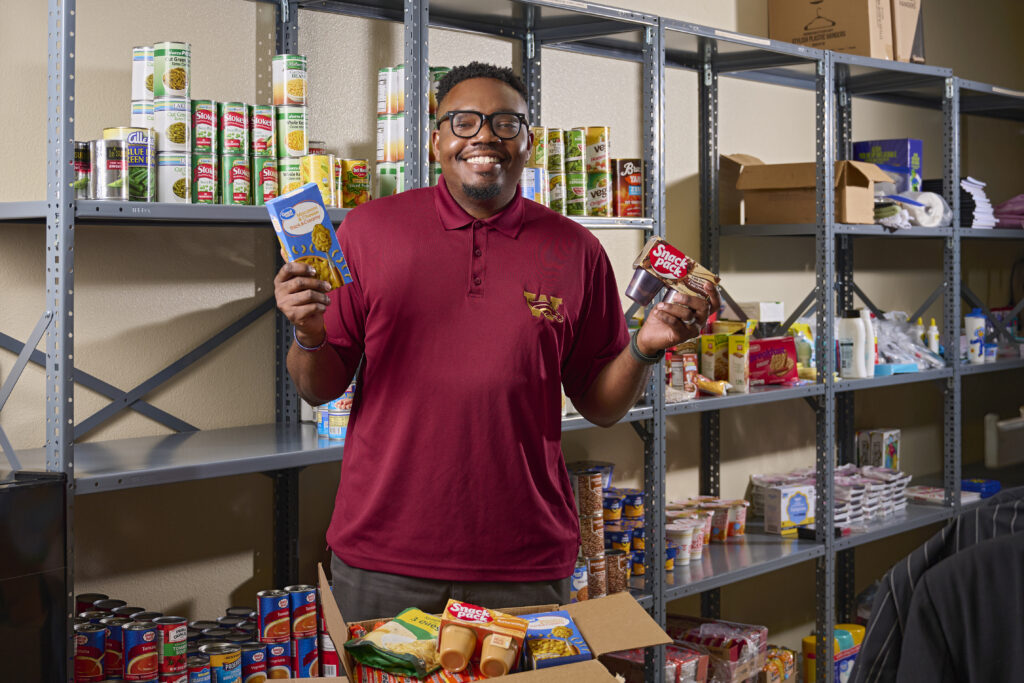
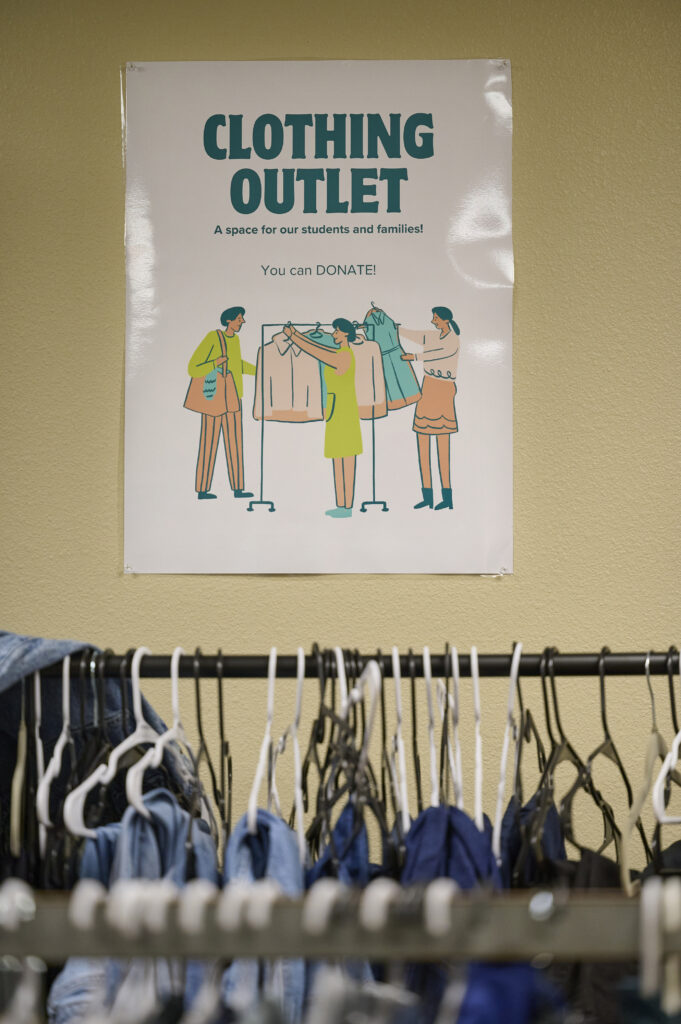
For the first phase of Wekiva’s transformation, community school director Johnny Outing aims to officially open the Mustang Market — a food pantry — and a clothing outlet for families in need around the end of the school year. Wekiva is also renovating a space to reopen as a multi-purpose family resource center.
“That will be utilized for organizations who come in and want to teach things like resume building and how to have a proper interview,” Outing said. “We’ll also use that space for a Zen room for emotional health support, where they can come in and they can talk to a therapist, talk to a counselor.”
Although he graduated from Southeastern University with a bachelor’s degree in pre-law, Outing said he found his “passion and purpose” in education. He taught English language arts at three elementary schools before arriving at Wekiva in March. Since then, he’s spent most of his time building relationships with local nonprofits and businesses.
“It’s a lot of mobilizing and organizing work, of explaining what a community school is to people who are in close proximity to the school, and then trying to convince them that what you do would be beneficial for our school, and what we do would be beneficial to you,” Outing said. “It’s a lot of that, and then the building out of our spaces, and conversations with graphic companies and paint companies of what does it look like to redo these spaces.”
According to Tarcha Rentz, UPI director of sustainability at UCF, community schools receiving the UPI grant are usually Title I feeder schools for UCF and its three UPI university partners — Florida Agricultural and Mechanical University (FAMU), Florida International University and the University of South Florida.
Rentz said UCF oversees two kinds of community schools: community partnership schools and UACS schools like Wekiva. Orange County’s only other UACS school is Colonial High School in east Orlando.
“The first community partnership school in Orange County and in the state is Evans High School — it’s considered the flagship,” Rentz said in an interview. “It started this journey a little over 14 years ago.”
UCF calls community partnership schools “enhancement sites,” since these were already community schools before UCF’s involvement. OCPS currently has four enhancement sites. As UACS schools, however, Colonial and Wekiva are just beginning their community school journeys and their involvement with UCF.
“With UCF, because we’re such a great big institution with so many students and colleges, we have this huge potential to really meet the needs of the community, the teachers [and] the students,” UCF’s Stella Cervantes, the Toni Jennings Exceptional Education Institute program coordinator, said in an interview.
Cervantes said UCF provides workshops for teachers on topics ranging from AI implementation to de-escalating relationships and conflicts with students. UCF is also working on providing internships at UPI schools for students pursuing bachelor’s and master’s degrees in social work.
“We know those are high-need schools, and the students at the schools could use some counseling,” Cervantes said.
Rentz also said UCF may place work study students at Wekiva next semester. An initiative led by UCF clinical associate professor of physical therapy Jennifer Tucker may also arrive at Wekiva in the near future.
“One of our faculty members is actually preparing to bring in one of her programs called Go Baby Go!, where students will learn how to wire cars for children with disabilities, to be able to make those cars accessible and useful for young children to be able to just have some normalcy in their lives,” Rentz said.
Amid all the features of the school’s new designation, Wekiva principal Anthony Russell said it boils down to helping students who struggle with basic needs to thrive.
“This means the systematic removal of non-academic barriers, such as food insecurity or chronic social needs, that currently hinder learning,” Russell said. “By addressing these foundational needs in partnership with the community, we free our students to focus entirely on academics, ultimately leading to improved attendance, greater family engagement, and significantly stronger educational outcomes, securing a more supported and brighter future for every Mustang.”
Outing said that the community school concept is over 100 years old — but that time period was vastly different from today.
“If we lived in the same community, that means we go to the same grocery store, go to the same library, go to the same school,” Outing said. “Now, we have globalization, and we have just the mere fact that students go off to college, and then sometimes, they don’t come home.”

Outing said community schools are about adding a system to what was once “organic.”
“That is the beauty of the work,” Outing said. “We’re trying to fight against the things that have created the separation.”
Outing believes the key to this “fight” is building relationships, which is part of what drew him to the role of community school director in the first place. And those relationships start with those between older, wiser adults and the student body.
“I get excited for anything that has to do with students receiving outside services and/or help with other adults who are pouring into them, not just academically — there’s a component to that — but just who they are as a person,” Outing said. “Numbers don’t lie; they tend to be more successful. And I don’t even mean ‘successful’ in a production standpoint of job and money earned, but just successful in their humanity, the type of person that they become.”
Outing uses this more holistic vision as the foundation for the relationships he builds with potential community partners, as he believes it is crucial to the longevity of Wekiva’s community school status.
“If you don’t have the people that you work with willing to do the work of deconstructing the traditionalism that we’ve lived in for so long, then it won’t matter,” Outing said. “It’ll be a nice, cool thing that will fade and become a fad. It won’t be sustainable. And that’s the goal — to try to create something that lives a lot longer than you.”
Author
Suggested Articles
No related articles found.