




Photo by Dana O'Connor
Key Points
- Apopka holds a crucial election with eight charter amendments and four of five City Council seats up for grabs on Tuesday.
- Voters may decide to switch from a strong mayor system to a council-manager system, which reduces mayoral powers and hires a city manager.
- Three candidates compete for mayor, with a potential runoff on April 14 if no one gets over 50% of the vote.
With eight proposed charter amendments – including one that could change Apopka’s form of government – and four of five City Council seats up for grabs, Apopka faces one of the most consequential elections in its history on Tuesday.
“The city of Apopka has a pretty big election coming up in terms of the future of this city, more so than the average election,” said Aubrey Jewett, a political science professor at the University of Central Florida.
At the top of the ballot is a three-way mayoral race between Orange County Commissioner Christine Moore, incumbent Mayor Bryan Nelson and City Commissioner Nick Nesta. Voters will also decide contests for council seats 1 and 2, and special election for seat 4.
Since its founding in 1882, Apopka has operated under a strong mayor structure, in which the elected mayor serves as the city’s chief executive and oversees day-to-day operations – something Jewett called “a little unusual” for a small town, which more commonly has the council-manager form.
The proposed change would instead place administrative authority in the hands of an appointed professional city manager, hired by and accountable to the City Council. Under that model, the mayor’s executive powers would be significantly reduced.
“Combined with the charter amendments, it makes the stakes for the mayor’s race a little bit higher,” said Jewett, who noted that roughly two-thirds of Florida cities operate under a council-manager system.
Supporters say an upside of this type of government is hiring a trained professional with experience managing municipal operations. Critics describe this person as an unelected bureaucrat who would not be accountable to voters while handling hiring and firing of city employees.
“You lose potentially strong political leadership in the executive branch,” Jewett said.
All three candidates have committed to serve a full term, regardless of which form of government voters choose. The outcome will impact how much the next mayor can manage the city’s growth.
“To some degree, this election weighs in on how well this city has handled existing growth, and who’s best equipped to lead it through the expected growth,” Jewett said.
Possible runoff
With three candidates competing for the mayor’s seat, the possibility of a runoff looms large. To win outright, a candidate must secure more than 50% of the vote. The potential runoff is scheduled for April 14.
“It seems to me that the odds favor the possibility of a runoff,” Jewett said.
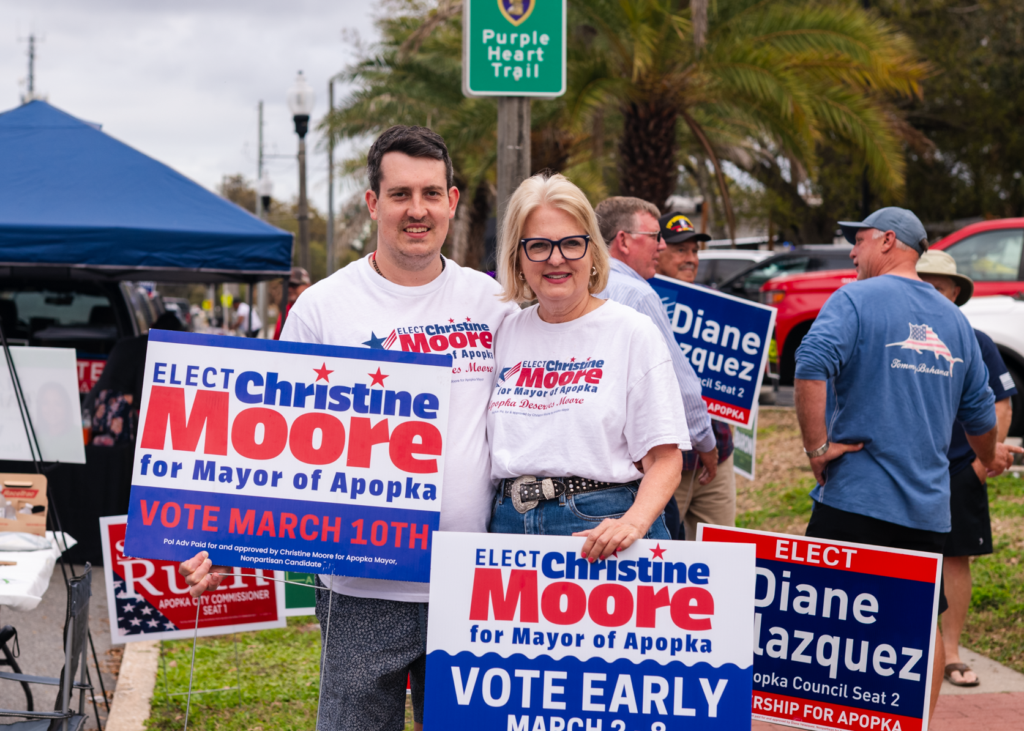
Incumbents typically enjoy advantages in municipal races, he said, but that dynamic can shift when challengers have prior elected experience or established name recognition, such as the current Apopka mayoral race.
Voter turnout could prove decisive. Spring municipal elections in Florida often draw around 20% of registered voters, Jewett said. If a runoff is required, participation could drop even further – potentially into the 10% to 12% range, he added.
“Let’s say it’s 35,000 [registered Apopka voters],” he said. “If you only got a 10% turnout, you’re talking three or four thousand voters, maybe.”
As of noon Wednesday, voters had cast 868 early ballots, to go along with 1,578 vote-by-mail ballots, according to the Orange County Supervisor of Elections. Early voting runs through Sunday.
In the 2022 Apopka general election, voters cast 1,622 early ballots and 3,128 by mail. The total voter turnout of 6,817 equated to19.3% of 35,233 registered voters.
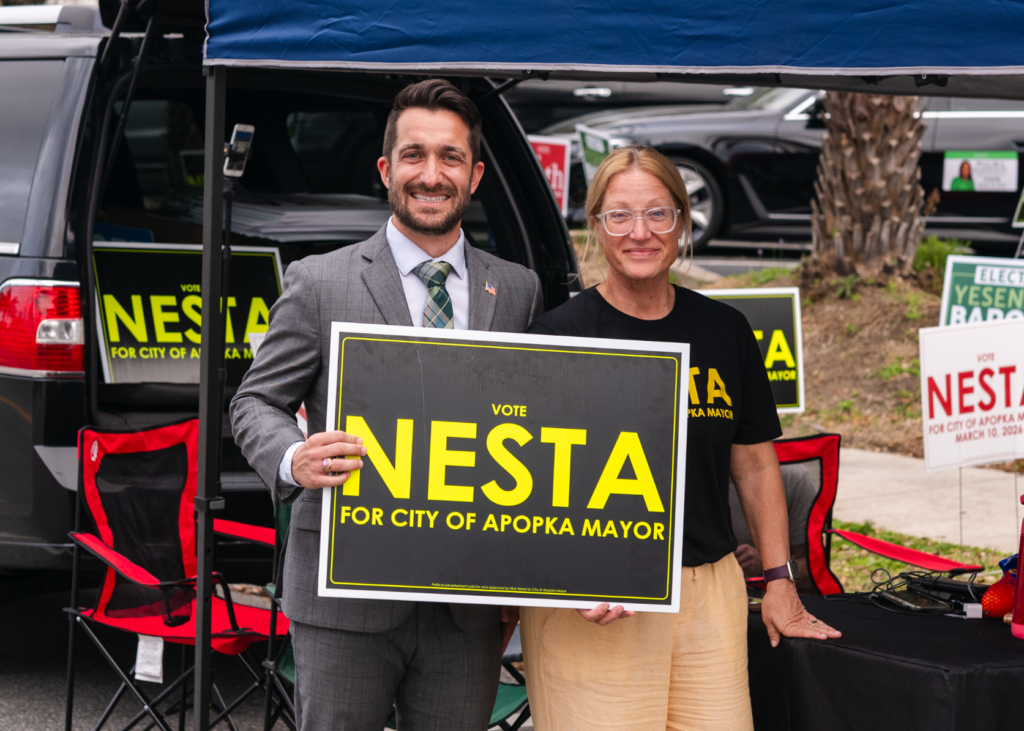
Outside the Apopka Community Center, one of two early voting sites, campaign signs populate the Central Ave./Fifth Street areathroughout the week. Along Fifth Street, candidates and campaign volunteers man the tents, encouraging voters to cast their ballots. Motorists drive down Fifth Street honking and waving to the candidates expressing their support.
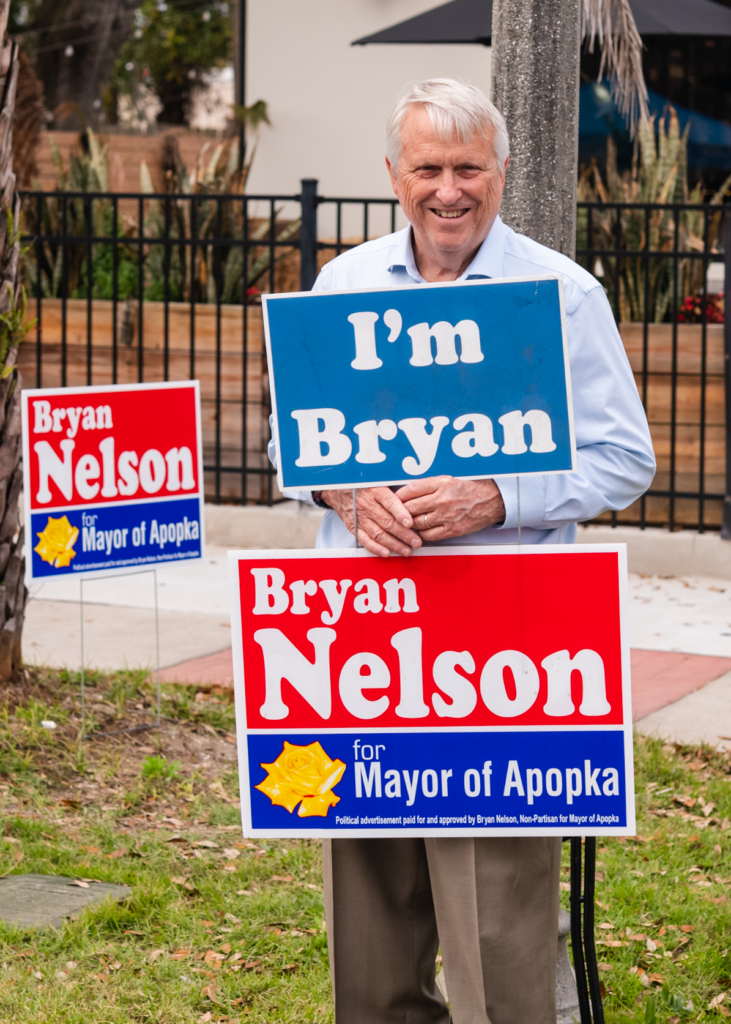
Early voting runs 7 a.m. to 7 p.m. from March 2 to March 8 at the Apopka Community Center (519 S. Central Ave.). Voters may also cast their ballots from 7 a.m. to 7 p.m. through March 8 at the Orange County Supervisor of Elections Office (119 W. Kaley St., Orlando).
Jewett noted how it’s common to claim the next election is always the most important, but he said that’s true to a different degree for Apopka.
“When you look at the numbers of people that are up – four of five seats … the possibility is there for big change,” he said.
Resident Kit Lamont agreed. After finishing early voting on Tuesday, she told the Chief she considers this election one of the most consequential in years.
“I vote in all the elections,” Lamont said. “However, this election is probably one of the most important ones that have been out there. Just with what happens next in Apopka is going to be very important with the overall growth and development, so I want to be a part of that.”
Closing arguments
The candidates continue making their closing arguments to voters in the final stretch of the campaign as residents head to the polls. Moore called the final days exciting as she meets and speaks with locals at the Apopka Community Center.
In a statement to the Chief, she encouraged residents to stop by her tent if interested in serving on committees such as infrastructure, parks and recreation, arts and culture, historic preservation, and conservation and trails.
“My platform speaks about creating new citizen-led committees which can effectively hold different departments accountable,” she said.
Nesta, who was at his campaign tent, said he intends to spend time there from 7 a.m. to 7 p.m. every day, including Election Day. He emphasized a mix of in-person neighborhood canvassing and social media engagement to reach voters and said he’s confident about the election.
“We want to be here for everybody to come talk to us, whether you like me or not,” he said.
In a statement to the Chief, Nelson highlighted his administration’s record, including lowering property tax rates, reducing water rateincreases, revitalizing downtown Apopka, and securing millions in grants.
“In the last eight years we have made great progress by increasing our reserves from less than $4 million to currently almost $40 million, which will help us weather any financial challenges that might come our way,” Nelson said before noting several projects in process, including new sports fields and Kelly Park Road construction beginning next month. “I would be honored to serve one more term to complete all of these exciting projects on time and on budget and humbly ask for your vote.”