



Courtesy of Paul Tambrino
Key Points
Last Saturday about 125 people gathered at American Legion Post 243 in Oviedo to dedicate a monument to the Four Chaplains, World War II heroes previously honored with memorials in Washington, D.C., Philadelphia, and Arlington, N.J.
When these four men gave their lives together, aboard the USAT Dorchester in 1943, it captured the attention of the nation. But now 83 years later, many have never heard their story.
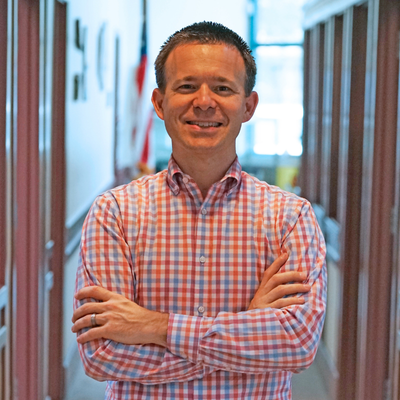
Thanks to my friend Paul Tambrino, who participated in the Oviedo ceremony, I was able to take my three sons to the event and learn this fascinating history, which is worth retelling.
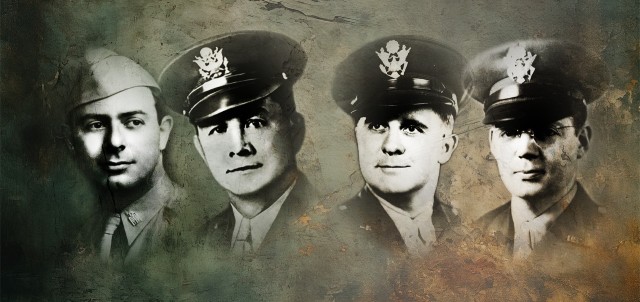
Here is his brief summary of the characters involved:
- George Lansing Fox earned a Silver Star, Purple Heart and the French Cross in World War I. Fox later studied theology and was ordained by the Methodist Church. After the Japanese attack Pearl Harbor, Fox, then 41, volunteered to serve his country again, this time in the Corps of Chaplains.
- On Nov. 11, 1921, 10-year-old Alexander David Goode was moved to tears as he stood at Arlington National Cemetery to watch America’s unknown soldier laid to rest. In high school, Goode joined the National Guard, then later became a rabbi like his father. When WWII broke out, he joined the Corps of Chaplains.
- Clark Poling was ordained in 1938, the latest in a long family line of ministers. When WWII came, Poling was married with a 2-year-old son, and his wife was expecting. “Don’t pray for my safe return,” he told his father. “Pray that I do my duty.”
- John Washington was the first of seven children born to Irish immigrant parents in Newark, NJ. John became a Roman Catholic priestand in 1937 was assigned to St. Stephen’s in Arlington, N.J. He had served there five years when WWII erupted.
These Army chaplains, a Catholic, a Jew and two Protestants, found themselves together aboard the Dorchester, a converted luxury cruise liner originally designed to carry 314 cabin passengers in style. Guttered and refitted, she had become a troop ship.
On Jan. 22, 1943, 902 soldiers trudged aboard, bound for Greenland with three Coast Guard cutters escorting them. Two patrolled its flanks, while the third, the Tampa, was 3,000 yards out front.
On Feb. 2, the Tampa dropped back and swept the periphery, looking for German U-boats, before returning to the front. They were only 150 miles from their destination.
Just after midnight on Feb. 3, a German U-boat delivered a torpedo into the Dorchester engine room. The ship took on water rapidly and began listing to starboard. Without power, the radio was silenced. No one thought to send up a distress flare. The escort vessels pushed on into the darkness, unaware that the Dorchester was sinking.
The four chaplains calmly worked on the sloping starboard side, guiding men to their boat stations, opening a storage locker and distributing life jackets. They coaxed men, frozen with fear, over the side.
One survivor, engineer Grady Clark, saw the four chaplains coolly handing out life jackets until there were no more left. Then he watched in awe as they gave away their own. As Clark swam away, he looked back and saw the chaplains standing, their arms linked, braced against the slanting deck. They were praying. There were no more outcries, no panic, just words of prayer in Hebrew, in Latin and in English, addressed to the same God.
Of the 902 men aboard the troop carrier, 672 were lost. Those who lived never forgot the chaplains’ heroism. By a vote of Congress on Jan.18, 1961, a Special Medal of Heroism (the only one ever given) was posthumously awarded to the four chaplains. Since then, Feb. 3 has officially been Four Chaplains Observance Day.
Author
Suggested Articles
No related articles found.