



Dana O'Connor
Key Points
- Apopka mayoral candidates debated city growth, infrastructure, and utility hikes before about 500 attendees at Apopka High School on Tuesday night.
- Candidates discussed a potential charter amendment to make the mayoral role ceremonial and addressed ongoing legal disputes involving residency and ethics complaints.
- The municipal general election is March 10 with potential runoff on April 14. The last day of voter registration is Feb. 9.
Apopka’s three mayoral candidates addressed their visions for the city’s elected mayor during the first debate of the 2026 municipal election cycle, touching upon issues ranging from growth and infrastructure to utility hikes and even legal challenges as public officials.
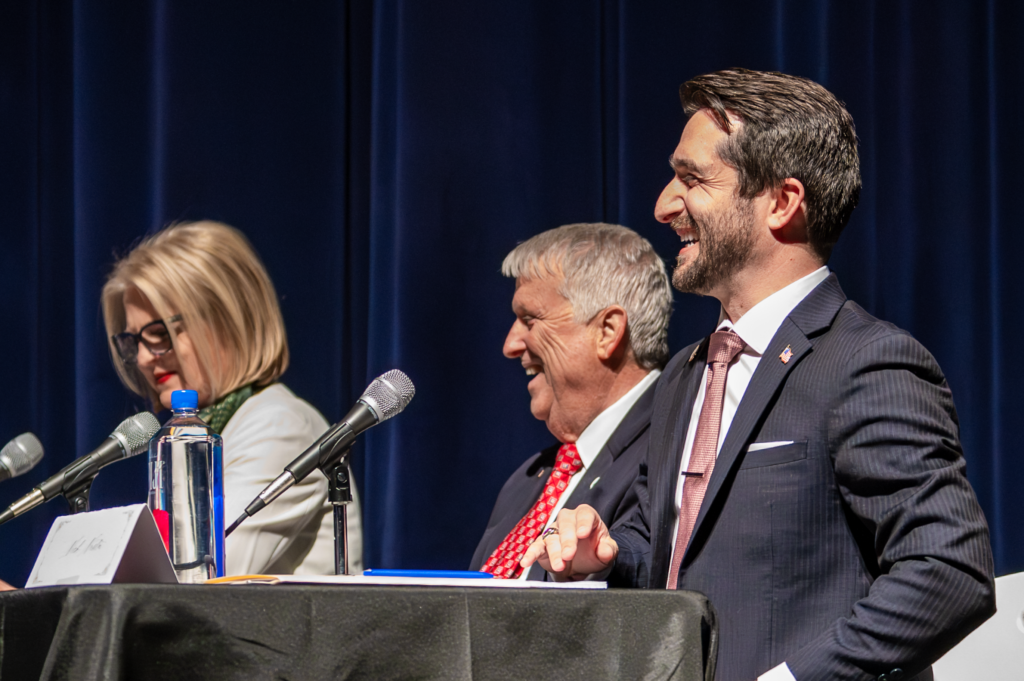
Around 500 people attended the Apopka mayoral debate Tuesday night at the Apopka High School Performance Arts Center. The Apopka Chief, WESH 2 News, and the Apopka High School PTSA co-hosted the event, which was sponsored by Maynard Nexsen law firm. Chief publisher J.C. Derrick and WESH 2 reporter Greg Fox served as co-moderators.
Orange County Commissioner Christine Moore, City Commissioner Nick Nesta and incumbent Mayor Bryan Nelson addressed a range of issues impacting the city, including infrastructure, affordable housing, and the impact of potential property tax reform state lawmakers are considering during the current legislative session.
One topic the debate focused on was how Apopka, as Orange County’s second largest city with more than 66,000 residents, should finance the “growing pains” of its expansion.
In his opening statement, Nelson defended his two-terms as mayor, citing more than a $30 million reserve and a reduction in general fund debt to under $2 million, freeing up over $1 million for infrastructure and public safety.
“We have found our way out of a hole,” Nelson said, arguing that the city is in a much stronger financial position than when he took office eight years ago.
Nesta and Moore talked about the fiscal burden placed on current residents, such as the combined water rate increase of almost 40% over the past two years.
Nesta, who voted against the rate increase in September, said the city is improperly using utility funds to help subsidize the general fund by over $6.8 million.
“We can’t afford this increase,” Nesta said, adding that inaccurate meter data has hurt residents.
Nelson said that the increased rates are necessary to maintain the city’s investment-grade status and fund essential wastewater plant debt.
Moore noted that water rates have been increasing in cities around the county due to inflationary pressure.
Moore took aim at the city’s approach to growth, saying it has been fragmented. She and Nesta expressed concern that Apopka’s infrastructure maintenance is “a bit of a Ponzi scheme,” where new development fees are used to pay for old debts while existing roads and sidewalks crumble.
She highlighted her experience as chair of MetroPlan Orlando, which coordinates transportation projects across Osceola, Seminole and Orange counties
“I will tell you, you cannot fix these roads without partnerships,” she said.
All three candidates spoke about a proposed charter amendment that could, if approved by voters, make the mayoral role to more ceremonial and shift much of its authority to a new city manager. Each candidate pledged to serve the full four-year term, regardless of the outcome of the charter amendment vote.
The candidates took different approaches on the subject of annexation for south Apopka. Moore said she supported annexation, while Nesta said he thinks the people should decide, while Nelson said he does not support it, citing studies that showed it would not make financial sense for residents.
Toward the end of the debate, the discussion turned contentious as it touched upon candidates’ legal issues.
When asked about the lawsuit Nelson filed against Moore alleging she didn’t live within the city proper in time to run for mayor, Moore said she did what she needed to do to qualify properly.
“I wanted to be part of the solution,” Moore said. “I’m in the historic district.”
Nesta said a recently dismissed ethics complaint against him was politically motivated. The ethics complaint alleged a conflict of interest in which he advocated for a $50,000 city grant to a nonprofit executive run by a real estate client of his, and that he should have recused himself from council votes.
“I wasn’t worried about [the complaint] to begin with, and I’m not worried about it now,” Nesta said, adding that his client never took a salary from the nonprofit.
Nelson echoed that political motivation was behind the censure vote against him in 2023 for allegedly lying about former city attorney Michael Rodriguez’s employment status. Nelson cited four presidents in U.S. history that were also censured, including Abraham Lincoln.
“Abraham Lincoln was one I feel pretty proud to be associated with,” Nelson said.
On the ballot this election cycle is mayor, City Council seats 1, 2 and 4 and eight proposed city charter amendments.
The municipal general election is March 10 with potential runoff on April 14. The last day of voter registration is Feb. 9.
To watch the full debate, click here.
Editor’s note: This story has been updated.
Author
Suggested Articles
No related articles found.