



Rey Villavincencio
Key Points
- The Apopka City Commission voted 3-2 to grant a developer’s appeal concerning the Live Local Act intent dispute for workforce housing.
- The dispute centered on whether the developer’s emails and forms constituted a legally sufficient notice of intent before July 1, 2025.
- The project site is in a Wekiva protection area excluded from new Live Local projects, causing staff to deny it under current rules.
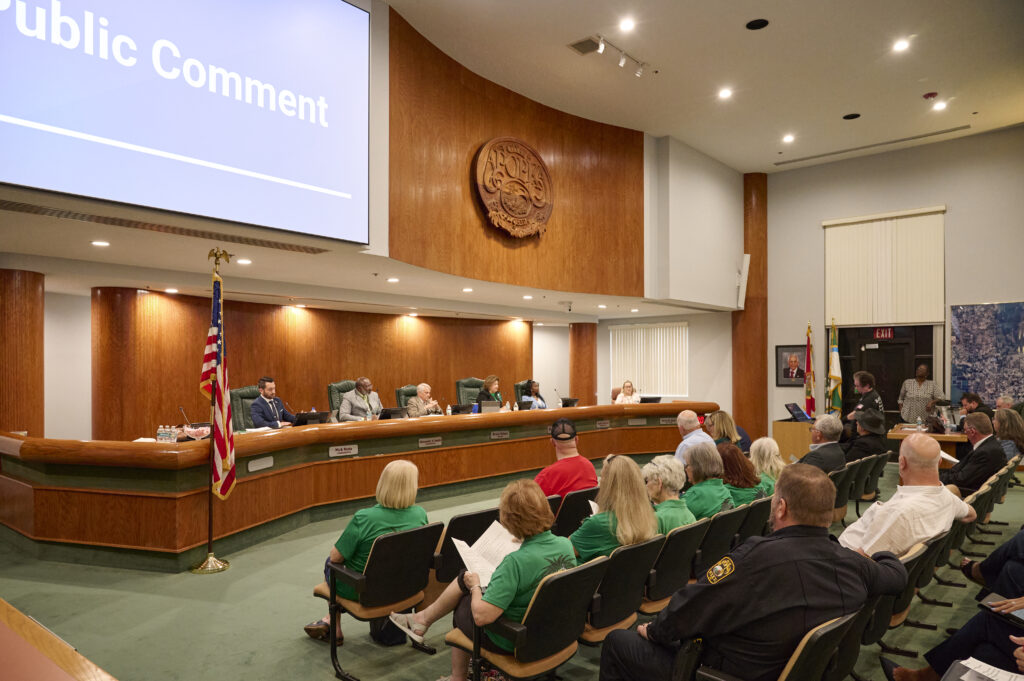
The Apopka City Commission spent more than an hour at its Wednesday meeting grappling with a key legal question that could shape whether a proposed workforce housing project can move forward: What exactly counts as “intent” under the state’s Live Local Act.
After extensive debate, the commission voted 3-2 to grant the developer’s appeal, with Commissioner Nick Nesta and Vice Mayor Diane Velazquez in opposition.
At the center of the dispute was whether the developer’s emails, signed forms and communications with city staff constituted a legally sufficient ‘notice of intent’ under the Live Local Act — a term the statute does not define, leaving commissioners to apply their own interpretation.
The appeal involves a proposal by Dora Point LLC to build a multi-family development at 1265 Rock Springs Road. City staff denied the request, concluding the project did not qualify to proceed under the 2024 version of the Live Local Act before a July 1, 2025, change that excluded the Wekiva study and protection areas from new Live Local projects.
The roughly 4.56-acre property at 1265 Rock Springs Road is designated for commercial use, where multi-family housing would not typically be allowed without the Live Local Act.
City attorney Cliff Shepard said the issue was whether the applicant took action that triggered development rights before that deadline.
“The question is, did the applicant trigger Live Local rights before July 1, 2025?” Shepard said, adding that “intent does not equal entitlement.”
Staff argued the developer’s communications – primarily emails asking about density, setbacks and other requirements – were typical early-stage inquiries, not a formal step that would qualify as a notice of intent under the law.
Because the property lies within a Wekiva protection area that was excluded from new Live Local projects under rules taking effect July 1, staff concluded the project no longer qualified to proceed under the earlier law.
But the applicant’s attorney, Jimmy Crawford, argued the city applied too narrow of an interpretation of the statute, which allows projects to proceed if an application, written request or notice of intent was submitted before the law changed.
“The statute says exactly what it says,” Crawford told commissioners.
He pointed to December 2024 verification forms signed by the city’s planning manager, along with emails referencing the specific property, as evidence the city had clear notice of the project.
“I don’t know how clear you could be,” Crawford said, citing language stating the developer ‘would be pursuing the site under the Live Local guidelines.”
Supporting that argument, Natalie Arrowsmith, the project’s realtor, told commissioners the development team had ongoing discussions with city staff.
“We did have multiple communications with the city staff via phone call,” Arrowsmith said, adding she met with staff to discuss whether the project qualified under the Live Local Act.
Commissioners acknowledged the law leaves room for interpretation. Commissioner Nadia Anderson noted the city has no formal standard for determining intent.
“There’s no process. We don’t have a form,” she said. “So, it’s hard to say that they didn’t meet the standard.”
Shepard maintained that intent must rise to a level that triggers administrative review, not just general interest.
“The question really boils down to … do you think it goes from inquiries … to a notice of intent?” he said.
Commissioners appeared divided, with some questioning whether the developer demonstrated an “intent to proceed,” while others referenced a similar case the city previously lost in court.
Crawford warned denial could lead to litigation, noting state law allows the prevailing party to recover attorney’s fees.