



Key Points
- Christine Moore and Nick Nesta debated at Victory Church on Monday, outlining plans for Apopka's development, parks, public safety, and transparency.
- Nesta led the March 10 mayoral race with 41.6% of votes; Moore followed with 31.85%, advancing to the runoff on April 14.
- In closing statements, Moore emphasized collaboration and experience, while Nesta Nesta reiterated his commitment to residents, transparency and leadership on the commission.
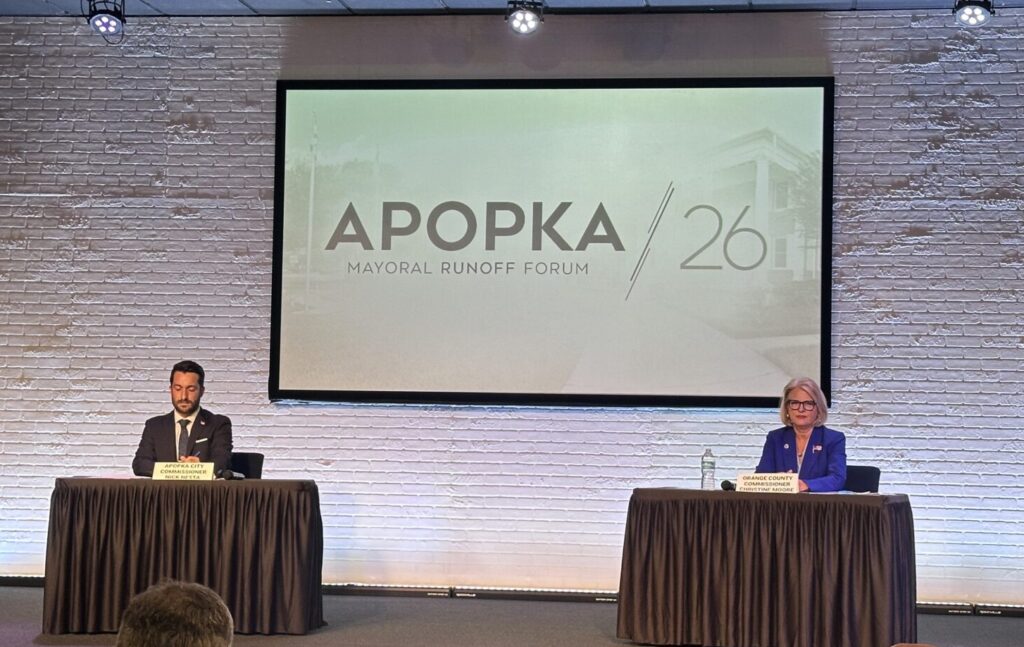
Orange County Commissioner Christine Moore and City Commissioner Nick Nesta faced off Monday in what is expected to be the mayoral runoff election’s only debate forum, where residents learned about the candidates’ plans for addressing city issues such as development oversight, infrastructure, parks and recreation, government transparency and public safety.
The Apopka Involved Voters Mayor Runoff Forum took place at Victory Church on South Park Avenue. Hank Dunn served as moderator and oversaw occasional tense moments.
Dunn asked both candidates to identify their first action items and plans to implement them after being sworn in mayor. In response, Moore mentioned former City Commissioner Kyle Becker by name, prompting audible reactions and looks from attendees, as Becker sat near the back of the room.
“The first action is to be, make sure we have a really good manager, and it won’t be Kyle Becker,” she said.
When asked to make closing statements, Moore emphasized collaboration and experience.
“With Christine Moore, you’ll have a positive, collaborative relationship with county, state and federal agencies,” she said. “I will have no conflicts of interest as I will serve as your full-time mayor, and I will ensure growth pays for itself,” she said.
Nesta reiterated his commitment to residents, transparency and leadership on the commission.
“Apopka deserves leadership that isn’t afraid to ask the hard questions, challenge bad decisions and put residents’ needs first,” he said, later adding that he has “provided a roadmap to its success.”
Virginia Street, a local church member who attended the forum, described it as “very informative” and said the discussion allowed her to better understand how the candidates would involve residents in shaping Apopka’s future.
“Some of the questions that I have, of course, are going to be geared to how much the residents will be able to contribute toward the future,” Street said after the forum. “I see that both of the candidates have considered that.”
Street also expressed concern that issues like homelessness did not get as much focus, although she spoke to each candidate separately afterward about the unhoused.
Street said she is personally involved in helping some individuals vote.
“I attend the church, and there are seniors in the church that I will be taking to go vote, and then there’s also the unhoused that are also residents that I will be taking to go vote,” she said.
Concluding the night, Dunn encouraged voters to make sure they vote in the runoff on April 14.
“We urge every citizen to know the issues affecting Apopka, understand each candidate’s views on those issues, and, most importantly, exercise your right to vote in this important election,” he said.
In the March 10 general election, Nesta netted 3,365 votes (41.60%) in the mayoral race. Moore was second with 2,574 votes (31.85%), and incumbent Mayor Bryan Nelson came in third with 2,148 votes (26.55%).
Parks and rec
The candidates were asked how they would ensure city parks and recreation facilities keep pace with Apopka’s growth.
Nesta said he would rely on a resident-led parks and recreation committee to help set priorities and guide budgeting, stressed the need to “pivot quickly” as recreation trends and community needs change, and called for a strategic plan for Camp Wewa – including decisions about the pool and major upgrades – so that existing assets and new amenities like pickleball courts actually materialize and grow along with the city.
Moore said keeping parks and recreation aligned with Apopka’s growth starts with making sure new development pays adequate parks and recreation impact fees, as was done to purchase new park land at Sadler Road and U.S. 441.
She pointed to her work at the county level securing tourist development tax dollars – most recently $13.1 million for amphitheater improvements and additional soccer fields – and said those tourism funds can be an ongoing source for Apopka projects.
Moore also described bringing Visit Orlando staff to tour Camp Wewa to help rethink how to stop the city from losing more than $1 million a year there while still fully utilizing the park for residents, framing outside partnerships and better financing as key to expanding and upgrading facilities over time.
Public safety
Moore, whose campaign announced on Monday that Orange County Sheriff John Mina is endorsing her for mayor, stressed relying on experts while ensuring public safety standards are met.
“I haven’t heard from the chief [Lovetta Quinn-Henry) that she’s worried other than the fact that we’re still struggling to hire adequate police and fire,” she said, adding that the city should “follow national standards” and make sure staff are accurately tracking how long it takes to reach accident scenes.
Nesta focused on staffing and long-term planning.
“Our police are doing the best they can, our fire department’s doing the best they can, but they need a little more resources,” he said.
He pointed to his earlier push to add fire personnel and calling for a future Fire Station 7 and a police substation and training center in the Kelly Park area, funded through need-based budgeting rather than leftovers.
Development, infrastructure
Moore criticized developer-led community meetings as “the fox guarding the hen house” and said she would shift to staff-led meetings so residents get a clearer explanation of the rules and a more meaningful role in the process.
She also outlined an approach to road improvements that includes closer coordination with county and state agencies, pushing developers to shoulder more of the cost of added road capacity – such as having them build key segments directly – and bringing in engineering firms to move projects like the Rock Springs Road/Welch Road intersection forward more quickly.
Meanwhile, Nesta emphasized giving residents and frontline staff a bigger role in planning and budgeting, proposing resident-led advisory committees, greater access for commissioners and employees to share concerns, and revamped procedures so city processes and spending are more transparent and responsive.
He also repeatedly argued that Apopka is “still running the city as if it’s 2005 or 2010” and said the city should adopt artificial intelligence and other new technology to improve efficiency, modernize services and give residents a better interface with city departments.
Ethics, transparency
Moore said she would avoid conflicts of interest by serving as a full‑time mayor without outside real‑estate business, noted that state law already requires officials to file conflict‑of‑interest forms. She argued that she would not have to recuse herself from the city budget the way Nesta did.
She also tied transparency to structure, saying she would create new citizen boards and use public workshops in advance of major decisions to add oversight and community input.
Nesta pointed to the city charter and existing state ethics rules as the framework that should guide officials. He said those provisions need to be followed and enforced. He also linked transparency to giving residents clearer information through tools like more detailed budget and spending documentation, and greater access for commissioners and the public to ask questions about how taxpayer money is being used.