



Ralo Flores
Key Points
- About 200 people attended the fourth annual Legends of Apopka event honoring 28 Black community members and highlighting their biographies.
- Mayor Bryan Nelson said the Legends project aims to preserve African American history in Apopka to prevent it from being forgotten.
- City leaders honored civil rights leader Jesse Jackson during the event and proclaimed February 2026 as Black History Month in Apopka.
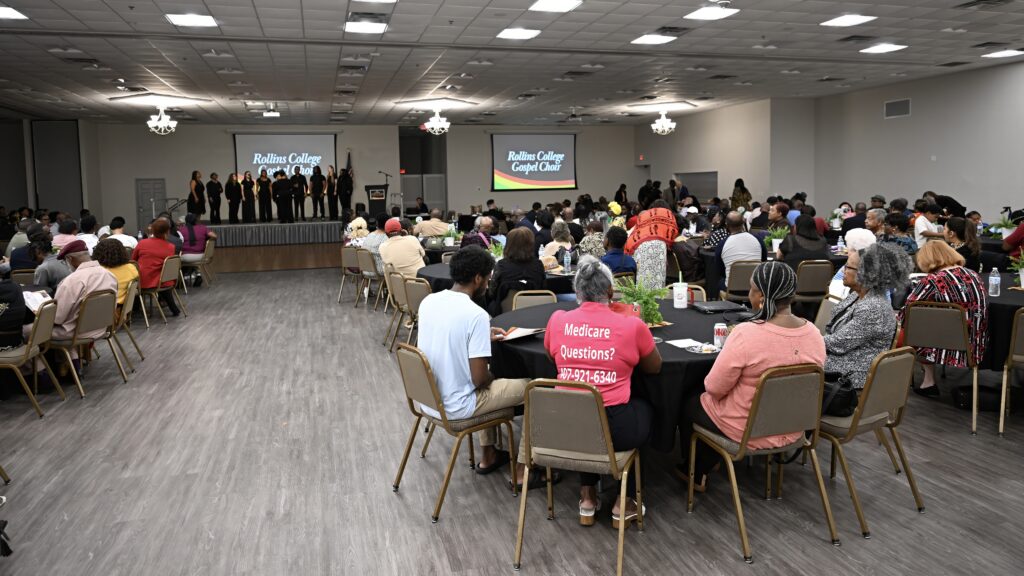
About 200 community members celebrated the Legends of Apopka in honor of Black History Month on Thursday night at the Apopka Community Center with music, a tribute to Black community members, and honoring civil rights leader Jesse Jackson, who died on Tuesday at age 84.
The city and the Apopka Youth Council recognized the 28 Legends of Apopka and their families in the fourth annual event.
The Apopka Youth Council compiled the fourth volume of “Legends of Apopka,” featured biographies of late Apopka community members, with help from Francina Boykin, vice president of the Apopka Historical Society.
At the celebration, as an Apopka Youth Council member read each Legend’s name, that individual’s family stood in recognition.
Mayor Bryan Nelson explained that the Legends of Apopka booklet grew from a desire to document the achievements of African Americans in the city before their stories were lost to time.
He said he asked Boykin to lead the effort with two specific requests: that the honorees span generations, including those born in the 1800s, and that the project focus on preserving history for the future.
“We want the history because 20 years from now, or 50 years from now, we’ll forget,” Nelson said.
Boykin thanked the Apopka Youth Council for helping to research and compile the biographies, along with city leaders for the opportunity and collaborators for their assistance in the project.
Several of the 28 honorees were people Boykin knew or whose stories were entrusted to her by elders. She recalled spending nearly a decade learning from several noted Apopkans, especially local historian William J. “Perrine Slim” Gladden Jr., who “poured into me so much history.”
“The people who we are honoring here tonight, the Legends, they’re not only people who are documented in their bios and are noted, but they are people I grew up with and [it is] not very hard to write about them,” she said.
She also highlighted Mead’s Bottom, a historic Black settlement established in the 1870s by former slave Sarah Mead, and recognized a resident believed to be the last surviving person born there. The Apopka Historical Society is working on placing a memorial marker at the site, where the Apopka City Center now stands.
“Document your history because your children and your grandchildren, your great-grandchildren – give them something to look back on and see what contributions that the family has made,” she said.
Music underscored the celebration as the Rollins College Gospel Choir performed under the direction of Andrea Green, as well as opera singer Mark Wright-Ahern.
City Commissioner Nadia Anderson called for unity during her remarks and acknowledged the recent death of Jackson, who stood alongside Martin Luther King Jr. during the Civil Rights Movement and founded the Rainbow PUSH Coalition.
“It’s so important in these times that we are united and we are one Apopka,” she said, noting the city flew the flag at half-staff in Jackson’s honor on Thursday.
“His life challenges each of us, especially those with us in public service, to lead boldly, to speak with truth, with conviction and to serve with compassion,” Anderson said before leading in a moment of silence. “May we honor him, not only in remembrance, but in recommitment to justice, equality and the work that still lies ahead. May he rest in power and his legacy continue to light our path forward.”
The fourth edition of Legends of Apopka include the following honorees: Norman Betts (1909-1977), Martha A. Board (1877-1970), Luvenia B. Braswell (1910-1976), Lula B. Chisholm (1886-1986), Wilbert “Buck” Chisholm (1929-2021), Johnnie Ruth Bailey Dowdell (1926-1980), Augnese Dudley (1932-1988), Ethel Green (1908-2000), Moses Howard, Sr. (1912-1997), Bernice Hughley (1931-2025), Mary Helen Landrum (1930-1987), Ruby Benton Lee (1931-2025), James Franklin McGraw II (1933-2020), Vernon McQueen (1947-2020), Clifford Moore (1927-2011), Alfred Neil (1929-2011), Roosevelt Nichols (1941-2008), William “Bill” Orr (1945-2025), Precious Patterson (1917-1998), David Rollie Richardson Sr. (1921-2014), Dr. Vera Rose-Poitier (1943-2011), Cato Sanders (1874-1939), Jacquelyn J. Smith (1951-2018), Barbara Studstill (1948-2025), Rossie Thomas (1936-2015), Samuel Weaver (1909-1983), Willie James Webb Sr. (1941-2011) and Daisy Bell “Slappy” Willis (1936-2020).
Nelson read a proclamation declaring February 2026 as Black History Month in Apopka. He previously read the proclamation at the Feb. 18 City Council meeting.
Now in its 100th year, the establishment of Black History Month goes back to 1915, when historian Carter G. Woodson and minister Jesse E. Moreland founded what later became the Association for the Study of African American Life and History.
In 1926, the association began National Negro History Week and chose the second week of February to coincide with the birthdays of Abraham Lincoln and Frederick Douglass as a week to commemorate African American achievements. Through Woodson and Moreland’s efforts, schools, communities and colleges organized local celebrations, history clubs and performances. In the decades following National Negro History Week, the event expanded into what eventually became known as Black History Month.
President Gerald Ford formally recognized Black History Month in 1976. Black History Month’s 2026 national theme is “A Century of Black History Commemorations.”
The fourth annual “Legends of Apopka” book was available for purchase for $10 per copy at the event.
For more information, visit Apopka.gov/BlackHistoryMonth.
Author
Suggested Articles
No related articles found.